Quick Summary:
- The UAE holds roughly 28.7% of all Middle East and Africa mobile app development revenue, the largest share in the region.
- Android runs 79% of UAE smartphones, so most local enterprise apps launch Android-first and add iOS second.
- A basic UAE business app costs AED 40,000 to 120,000 in 2026, and enterprise AI-powered builds can cost AED 1.5 million.
- Cross-platform frameworks now power roughly 60% of new Dubai app builds, cutting development cost by 30 to 40%.
- The UAE's new Federal Authority for AI and Data, formed in June 2026, now governs PDPL compliance for any app collecting UAE user data.
- UAE residents already complete 75% of online transactions on mobile, so delaying an app build costs real market share, not just visibility.
- Government-linked digital initiatives are targeting an additional AED 100 billion annual contribution from digital transformation, and app-based businesses sit directly inside that spend.
Dubai’s mobile app development market is the largest in the Middle East and Africa region, holding close to 28.7% of total regional revenue as of 2025, according to a 2026 mobile app development market report.
That position did not happen by accident. The UAE built the infrastructure years ago and kept investing while other regional markets slowed.
Three numbers explain where the market stands today. The UAE now runs the world’s fastest mobile internet, at a median download speed of 614.42 Mbps, up 54.2% year over year, according to Ookla-sourced smartphone data.
As StatCounter Global Stats stated, Android still dominates device choice. It holds 81.06% of the UAE smartphone market as of January 2026, against 18.8% for iOS. That split shapes almost every technical decision a Dubai development team makes before writing a single line of code.
UAE residents spend an average of 8 hours and 11 minutes online daily. Mobile accounts for 75.3% of all web traffic in the country. E-commerce has already reached 50% of total consumer spending, most of it completed on a phone.
Government money keeps flowing into this base. Digital Dubai is targeting an annual AED 100 billion economic contribution from digital transformation, tied to the Dubai Economic Agenda D33.
A newer initiative launched in April 2026 is projected to add AED 10 billion, about $2.72 billion, to GDP within two years through AI-driven government services alone.
None of this is unique to government contracts. Any founder building a consumer or enterprise app in Dubai right now is building into a market that already has the bandwidth, users, and funding behind it.
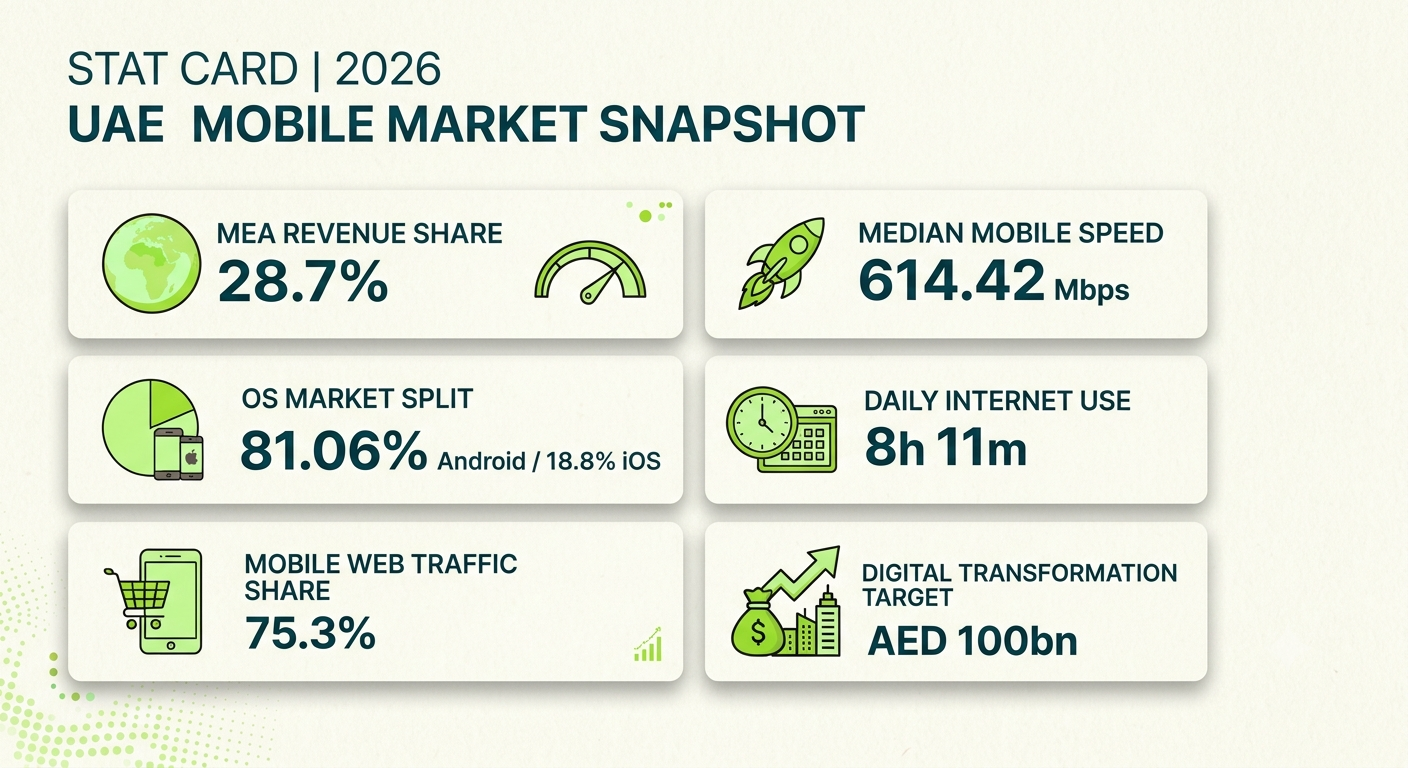
| Metric | 2026 Figure | Source |
| UAE share of MEA app development revenue | ~28.7% | SNS Insider |
| Median mobile download speed | 614.42 Mbps | Ookla / DataReportal |
| Android market share | 81.06% | GSMA-sourced UAE data |
| iOS market share | 18.8% | GSMA-sourced UAE data |
| Daily internet use per resident | 8h 11m | DataReportal |
| Mobile share of web traffic | 75.3% | DataReportal |
| Digital economy GDP target | 19.4% by ~2032 | UAE Digital Economy Strategy |
Why is the UAE’s Mobile App Development Market Booming in 2026?
The UAE’s app market is booming because government policy, consumer behavior, and infrastructure investment are all pulling in the same direction at the same time.
Government policy set the target first. The UAE Digital Economy Strategy aims to double the digital economy’s GDP contribution from 9.7% to 19.4% within ten years of its April 2022 launch. Every ministry and free zone is now building toward that number.
Startup formation followed the policy. The Dubai Chamber of Digital Economy supported 1,210 new digital startups in 2024, a 120% increase over 2023, according to UAE digital strategy reporting.
Infrastructure kept pace with demand. The UAE now hosts 38 data center facilities, with up to $1 billion in further data center investment projected through 2026. This gives app builders low-latency infrastructure without leaving the region.
AI adoption is compounding all of it. PwC estimates AI will contribute close to 13.6% of UAE GDP, about $100 billion, by 2030. That spending is flowing directly into AI-powered mobile products across banking, retail, and government services.
Put together, this is not a market growing because “digital is trending.” It is a market growing because policy, capital, and infrastructure were built in that order, deliberately, over several years.
How We Built This List: Our Ranking Criteria
Every company on this list had to clear four checks before being included, not just show up in a directory search.
UAE presence:
Each company needed a verifiable Dubai or wider UAE office, team, or delivery presence. Not just a marketing page targeting UAE search traffic from an offshore base.
Verifiable delivery record:
Client work, portfolio case studies, third-party review platforms like Clutch and GoodFirms, or direct company disclosures had to back every claim.
Platform range:
Companies demonstrated Android, iOS, or cross-platform delivery capabilities relevant to the businesses. Not a single narrow specialization with no mobile track record.
Transparency of information:
We prioritized companies with public, checkable information over unverifiable claims. We note in each profile where a company is internationally headquartered but UAE-serving, rather than implying a false local origin.
Top 15 Mobile App Development Companies in Dubai, UAE (2026)
1. Code Brew Labs
Code Brew Labs is a UAE-rooted mobile app development company founded in 2013, with 13+ years of hands-on delivery experience and a dedicated Dubai office at the Dubai World Trade Centre.
The company has delivered 2,600+ mobile apps globally across healthcare, real estate, fintech, and logistics. It holds a 95% client retention rate and runs CMMI Level 3 and ISO 9001-certified development processes. Its Clutch rating sits at 4.8/5.
Its portfolio includes AI decision intelligence work for aerospace leader Airbus, an e-commerce platform for retail brand REDTAG, a MENA logistics platform for Trukker, and fintech builds for Alfardan Exchange and duPay. The company has also delivered projects for government entities in the UAE.
Code Brew Labs runs its own in-house design studio, Allurive, and a proprietary customer analytics tool, Retainlytics. Both built to support clients past launch rather than handing off a finished app and disappearing.
Best for: Startups through Fortune 500 enterprises needing AI-driven, full-cycle mobile app development. They support product strategy through post-launch growth support, backed by a locally accountable UAE team.
See what a 13-year, 2,600-app track record can build for you
2. Suffescom Solutions
Suffescom Solutions is a Dubai-based mobile app development company that builds custom iOS, Android, and cross-platform applications for startups, SMEs, and enterprises. With over 13 years of experience, the company combines mobile development with expertise in AI, blockchain, and enterprise software to deliver scalable digital products across multiple industries.
The company reports delivering more than 250 mobile apps in the UAE, serving over 1,000 clients globally, and developing solutions for sectors including healthcare, fintech, logistics, real estate, and e-commerce. Their team focuses on agile development, bilingual (Arabic and English) applications, and business-driven app strategies tailored to the UAE market.
Best for: Businesses seeking a full-service technology partner to build custom mobile applications with AI, blockchain, and enterprise-grade capabilities, while supporting long-term scalability.
3. Royo Apps
Royo Apps is a Dubai-based mobile app development company, ISO 9001:2008 certified. They are known for modular, ready-to-customize app frameworks rather than fully custom ground-up builds.
The company reports having built over 2,180 iOS apps and works across transportation, e-commerce, healthcare, and logistics. They use modular architecture to cut both cost and time-to-market for on-demand and marketplace business models.
Best for: Startups that want to launch fast on a proven modular base instead of building every feature from scratch.
4. Blocktech Brew
Blocktech Brew is a Dubai-headquartered, Web3-focused development company.
It builds blockchain applications, decentralized apps, metaverse experiences, NFT platforms, secure Web3 wallets, and smart contract and DeFi systems.
Best for: Businesses building blockchain-integrated or tokenized mobile products that need deep Web3 engineering.
5. Dubai App Developers
Dubai App Developers is a Dubai-based mobile app development company building custom iOS, Android, and Flutter applications. They carry a positive track record on Clutch for project quality and client outcomes.
The company works across banking, fintech, e-commerce, blockchain, and social platforms, offering full-cycle services.
Best for: UAE businesses that want a locally headquartered team for both native and cross-platform builds.
6. Malgo Technologies
Malgo Technologies is a digital transformation company serving UAE startups, public-sector organizations, and enterprises. They have expertise in AI/ML, AR/VR, IoT, big data, and blockchain-integrated mobile builds.
Its services span custom, cross-platform, hybrid, and on-demand app development, alongside broader digital transformation work.
Best for: Businesses that want a mobile app bundled with wider digital transformation and Web3 capability.
7. Wall Street Mobile Apps
Wall Street Mobile Apps operates in the UAE, with a specific focus on fintech mobile applications.
The company builds iOS, Android, cross-platform, and wearable apps, with documented client work in trading, banking, and investment tracking.
Best for: Fintech founders who need a secure, real-time financial app with banking domain experience.
8. Kodehash Technologies
Kodehash Technologies is a full-service mobile app development company with an operating office in Jumeirah Village Circle, Dubai. The company has delivered 500+ apps and IT managed services across AWS, Azure, and Google Cloud.
Best for: Businesses that need mobile app development paired with CRM automation and cloud infrastructure.
9. Goji Labs
Goji Labs is a strategy-led digital product agency serving UAE and global clients from its US base. The agency states it has helped clients raise over $500 million in funding. Its work spans EdTech, FinTech, HealthTech, and marketplace products.
Best for: Startups that need product strategy and UX research built into the process.
10. ITP Media Group
ITP Media Group is a media company headquartered in Dubai, publishing more than 40 brands. Its in-house technology division builds and maintains custom apps for digital publishing, e-commerce, and entertainment.
Best for: Media, hospitality, and lifestyle brands that want an app built by a team with a direct understanding of local audience behavior.
11. Techasoft
Techasoft is a software development company with an active UAE office in Dubai. The company builds custom mobile apps, enterprise software, and NetSuite-integrated solutions, with delivered work in healthcare and e-commerce.
Best for: Businesses that want mobile app development bundled with ERP and NetSuite integration.
12. Folium AI
Folium AI is a software development company with a Business Bay, Dubai office. The company focuses on AI and machine learning integration, robotic process automation, cloud engineering, and custom mobile and web app builds.
Best for: Startups that want an AI-first mobile product without hiring and managing a separate in-house data science team.
13. Briskstar Technologies
Briskstar Technologies is an e-commerce and mobile app development agency. The company builds responsive websites, mobile apps, and CMS-driven platforms.
Best for: Businesses that need e-commerce, CMS, and mobile app work handled by a single long-established vendor.
14. Code Ethics
Code Ethics is a technology consulting firm with offices in Hyderabad and Dubai, founded in 2022.
The company offers web and mobile app development, software testing, cloud services, and data management, built around client-first delivery.
Best for: Startups and SMEs that want a lean, straightforward development partner for a focused mobile build.
15. ME Digital
ME Digital is a Dubai-based creative and growth marketing agency working across F&B, real estate, automobile, and technology. The agency builds digital experiences, brand platforms, and growth campaigns, with app-adjacent web and content.
Best for: Consumer brands that want an app or digital product launch tied directly to coordinated marketing.
Which Industries Do Dubai’s Mobile App Development Companies Serve?
Six industries currently drive most mobile app development demand in Dubai: fintech, healthcare, real estate, hospitality and tourism, e-commerce and on-demand services, and logistics.
Fintech and banking:
Digital wallets, mobile-first banking, and AI-driven budgeting tools are standard now. Since the UAE Central Bank is actively supporting digital payment infrastructure and crypto-adjacent frameworks.
Healthcare and telemedicine:
Hospitals and clinics are moving consultations, remote monitoring, and health records onto mobile. National initiatives like NABIDH are directly supporting these for connecting public and private providers across Dubai.
Real estate and property tech:
Virtual tours, AR-based visualization, and AI-powered mortgage tools are now expected features on any serious property platform in a market this transaction-heavy.
Hospitality and tourism:
Dubai draws more than 14 million tourists a year. Hotels, restaurants, and travel brands are building booking, loyalty, and AI concierge features directly into mobile apps.
E-commerce and on-demand services:
The UAE e-commerce market is projected to cross $10 billion by 2026, with the large majority of that volume completed on mobile.
Logistics and transportation:
Real-time vehicle tracking, route optimization, and inventory visibility are core mobile use cases as Dubai continues to expand its role as a global logistics hub.
Which Industries Are Just Getting Started With Mobile App Development in the UAE?
A second group of sectors is only beginning to adopt mobile-first tools. This is where the next wave of app development demand is forming.
Family offices and wealth management
As Dubai’s private wealth sector grows, firms are only starting to build client-facing portfolio, reporting apps, and wealth management apps, an underserved niche compared to retail fintech.
Education technology
AI became an official subject in the UAE public school curricula starting the 2025-2026 academic year. The schools are only beginning to procure the mobile tools that the curriculum and education structure require.
Legal and professional services
Legal consultancies are early in adopting mobile client-matching and case-management tools. This is the gap most law firms in the region have not yet closed.
Utilities and smart infrastructure
DEWA’s smart grid strategy is pushing utilities toward on-demand app-based customer interaction. The other utility providers are only beginning to follow that model.
Businesses entering any of these sectors now have a real first-mover window before mobile becomes the baseline expectation, the way it already has in fintech and e-commerce.
Android, iOS, or Cross-Platform: How Should You Decide?
The right platform choice depends on your target user base, budget, and how fast you need to reach the market.
Choose Android-first if reach matters most
Android holds 81% of UAE smartphones, so an Android-first build reaches the largest possible local audience fastest, especially for mass-market consumers and on-demand apps.
Choose iOS-first if your users are high-spend
iOS users in most global markets contribute a disproportionate share of app revenue. They have a smaller user base, which matters for premium fintech, luxury retail, or B2B enterprise tools targeting a smaller, higher-value UAE segment.
Choose cross-platform if speed and budget are the constraints
Frameworks like Flutter and React Native now power roughly 60% of new app builds in Dubai. This cuts development cost by 30 to 40% compared to two separate native builds.
Choose native development if performance is the product
Gaming, AR-heavy real estate visualization, and apps with deep hardware integration still perform best built natively, even at higher cost and longer timelines.
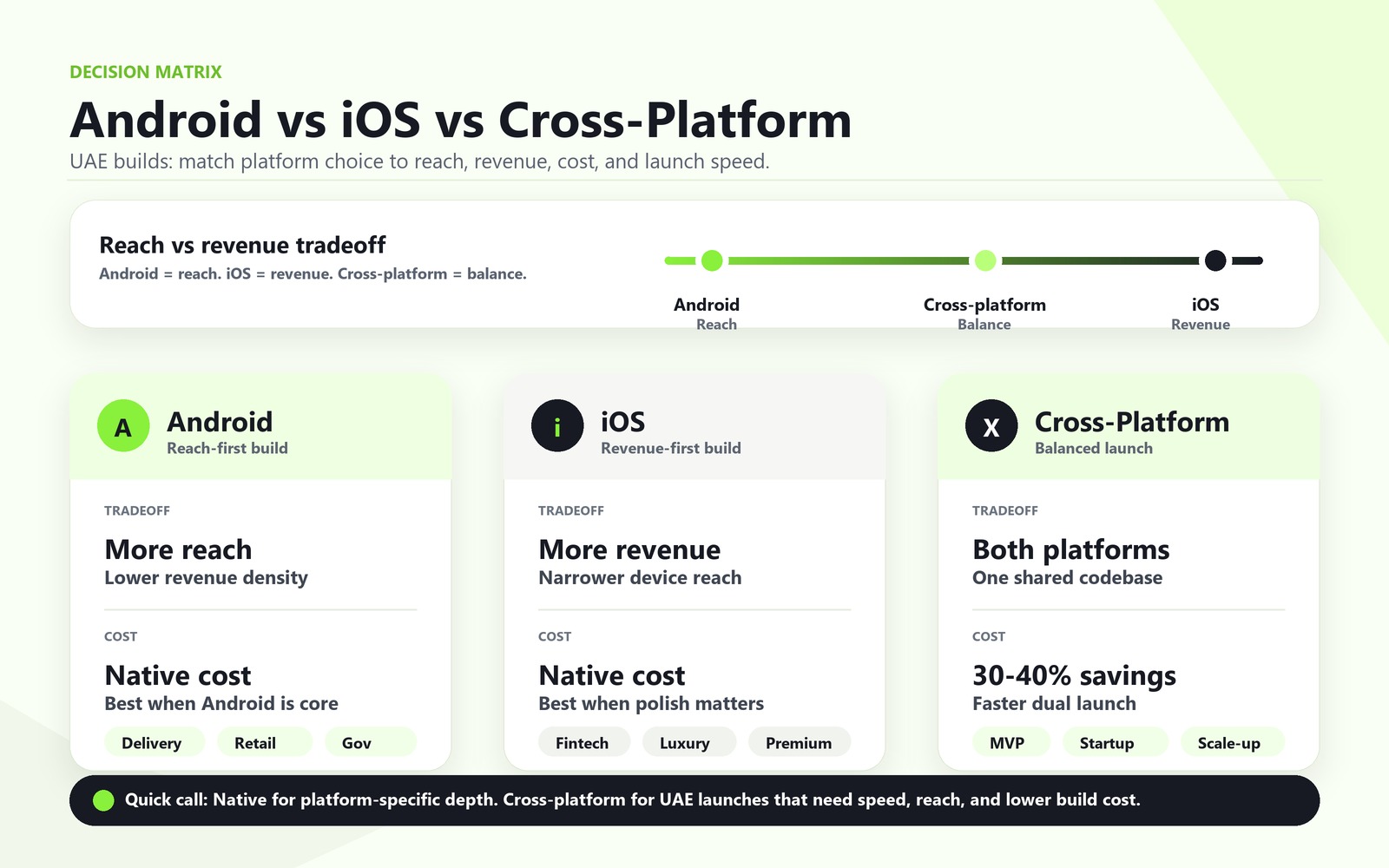
Most enterprise buyers in Dubai end up choosing cross-platform for the initial build, then layering native modules later for performance-critical features.
What AI Trends Are Shaping Mobile App Development in Dubai, UAE?
AI has moved from an optional feature to the default architecture for new mobile apps built in Dubai in 2026. One regulatory shift now shapes how every one of them gets built.
AI personalization is now a baseline expectation
Chatbots, predictive recommendations, and behavior-based personalization are standard in fintech, retail, and healthcare apps.
AI’s economic weight keeps growing
PwC estimates AI will contribute close to 13.6% of UAE GDP, roughly $100 billion, by 2030. That capital is flowing directly into AI-native product development.
Consolidated regulation changes the app architecture
On 14 June 2026, the UAE Cabinet approved a new Federal Authority for Artificial Intelligence and Data, merging the former AI Office, the Emirates Data Office, and TDRA’s digital government function into one body.
That consolidation matters directly for app development. Any app processing UAE user data now needs consent management, data subject rights handling, and cross-border transfer controls designed in from the architecture stage.
Government AI investment is compounding demand
Dubai’s AI-driven digital ecosystem push is targeting an additional AED 10 billion in GDP within two years. This positions the Emirates among the world’s top 10 cities in government AI readiness.
Cross-platform and cloud-native builds
With up to $1 billion in further UAE data center investment through 2026, cloud-native architecture on AWS, Azure, or Google Cloud remains the default choice for scalable app infrastructure.
For businesses building anything regulated, fintech, healthcare, or government-adjacent, this is the single biggest development shift of 2026.
How Much Does Mobile App Development Cost in Dubai, UAE?
A basic UAE mobile app costs AED 40,000 to 120,000 in 2026, with enterprise-grade AI-powered builds running well past AED 1.5 million depending on complexity.
Pricing splits into three practical tiers based on complexity and feature depth.
| Tier | Typical Scope | Indicative Cost (AED) |
| MVP / Startup app | Core features, single platform or basic cross-platform build | 40,000 – 120,000 |
| Mid-complexity business app | Multi-feature, payment integration, admin dashboard, cross-platform | 120,000 – 350,000 |
| Enterprise / AI-powered app | Custom AI features, complex integrations, high scalability, security compliance | 350,000 – 1,500,000+ |
Figures are indicative 2026 market ranges compiled from published UAE mobile app development cost benchmarks and vary based on the final scope. Request a project-specific quote before budgeting.
Platform choice moves cost significantly. Native app development for both iOS and Android typically runs AED 25,000 to 80,000 per platform for simpler builds.
While a single cross-platform build using Flutter or React Native can cost 30 to 40% less than building both platforms natively.
Complexity drivers that push costs up include real-time features. Third-party payment and identity integrations like UAE PASS, AI or ML components, and compliance requirements tied to PDPL or sector-specific regulations.
Tips to Choose the Best Mobile App Development Company in Dubai, UAE
Six checks separate a reliable UAE development partner from a vendor that looks capable on a pitch deck but underdelivers after the contract is signed.
Confirm a real UAE presence
Ask for a local office address and a point of contact based in the UAE. Not just a sales team targeting UAE search traffic from offshore.
Ask for named client references
Testimonials on a website can be selectively curated. A named reference willing to take a call is a far stronger signal of actual delivery quality.
Confirm PDPL and data residency approach
With enforcement now consolidated under the Federal Authority for AI and Data, any vendor without a clear answer on data handling is a compliance risk.
Match company size to your project’s complexity
A five-person boutique agency may be ideal for an MVP but wrong for a government-facing enterprise platform, and the reverse is equally true.
Review post-launch support terms
Ask specifically what happens to bug fixes, security patches, and feature requests once the initial contract ends.
Milestone-based contract structure
Fixed milestones with defined deliverables protect both timeline and budget far better than an open-ended time-and-materials agreement with no checkpoints.
Why Is Code Brew Labs the Best Mobile App Development Company in Dubai, UAE?
Code Brew Labs combines a genuine UAE-rooted delivery record with the enterprise infrastructure that regulated, high-stakes projects actually require.
Thirteen years of continuous operation and 2,600+ delivered apps are not a marketing figure. It is a body of shipped, working products across fintech, logistics, retail, and aerospace-grade enterprise clients like Airbus and Trukker.
A 95% client retention rate matters more than a high star rating. Clients who stay for repeat projects are telling the market something a single testimonial cannot.
CMMI Level 3 and ISO 9001 certification mean development processes are structured and auditable. This is exactly what enterprise procurement and government-adjacent clients need to see before signing.
The in-house Allurive design studio and Retainlytics analytics platform mean Code Brew Labs does not hand off a finished app and disappear. It builds the tools to keep improving it after launch.
For founders and enterprises that need a partner who understands UAE regulatory reality, AI-native architecture, and long-term product growth in one relationship, that combination is difficult to match on this list.
Ready to build with a 13-year, UAE-rooted team?
Conclusion
Dubai’s mobile app development market is not an emerging opportunity anymore. It is a mature, regulated, AI-native market with the infrastructure, capital, and government backing to reward businesses that move now.
The companies on this list range from UAE-native full-cycle partners to specialized boutiques. The right fit depends on your platform priority, budget tier, and how central compliance is to your build.
What has changed for 2026 is the regulatory layer. Any serious mobile app build in the UAE now needs PDPL compliance designed in from day one.
Businesses that treat that as a starting requirement, not an afterthought, will spend less fixing problems later and launch with far less risk.
If you are ready to scope a project against a UAE-rooted team with 13 years of delivery history, talk to Code Brew Labs before your next planning cycle starts.
Frequently Asked Questions
What are the top mobile app development companies in Dubai, UAE, in 2026?
Code Brew Labs ranks among the top mobile app development companies in Dubai for 2026, based on verified UAE presence, delivery record, and platform range. The right choice depends on project complexity, budget, and whether compliance or AI capability is a core requirement.
How much does it cost to build a mobile app in Dubai?
A basic UAE business app costs AED 40,000 to 120,000 in 2026. Mid-complexity apps with payment integration and admin dashboards run AED 120,000 to 350,000. Enterprise AI-powered apps with complex integrations and compliance requirements can exceed AED 1.5 million.
Should a UAE startup choose Android, iOS, or cross-platform development first?
Most UAE startups should choose cross-platform frameworks like Flutter first, since Android holds 81% of the local market, and cross-platform tools cut costs by 30 to 40%. High-revenue fintech or B2B products targeting a smaller, higher-spend user base may prioritize iOS instead.
How long does mobile app development take in Dubai?
Most mobile app projects in Dubai take 3 to 6 months from discovery to launch. This basically depends on feature complexity, integrations, and whether the build is native or cross-platform. MVPs can launch faster, often within 8 to 12 weeks, while enterprise-grade platforms typically take longer.
Does a mobile app built in the UAE need to comply with PDPL?
Yes. Any app processing personal data of individuals in the UAE must comply with the Personal Data Protection Law, Federal Decree-Law No. 45 of 2021. As of June 2026, enforcement is consolidated under the new Federal Authority for Artificial Intelligence and Data, making compliance a development-stage requirement.
Why do enterprises and government entities in the UAE prefer local Dubai-based app developers?
Local Dubai-based developers understand UAE-specific requirements directly, including Arabic-first RTL design, UAE PASS integration, PDPL compliance, and regional payment systems like Telr and PayTabs. Local accountability and regulatory familiarity reduce delivery risk on enterprise and government-adjacent projects compared to offshore-only vendors.
Let's Convert Your Business Idea Into Success!
Free Consultation from Top Industry Experts
Let’s Build Your Dream App!
Share article on :



 No commitment required
 NDA on request
 24-hour response