Quick Summary:
- Dubai Chamber of Digital Economy's Create Apps Accelerator launched 32 new mobile apps in its June 2026 cohort, as reported by Arabian Business, June 17, 2026.
- 60% of those mobile apps are AI-powered, launched by founders from 22 countries across 13 sectors.
- As per Synergy Labs, 80% of UAE venture capital firms are actively seeking AI-driven startups.
- According to Tribe Techie, the UAE has committed over $100 billion to AI investments, with a dedicated $500M AI fund for startups.
- Waveup reported that Dubai captured 93% of the UAE's H1 2025 tech funding, approximately $2 billion across 218 deals.
- UAE AI Office confirmed that the UAE AI Strategy 2031 targets AED 335 billion in AI-driven economic contribution.
On June 17, 2026, Dubai Chamber of Digital Economy confirmed what many UAE founders already sensed.
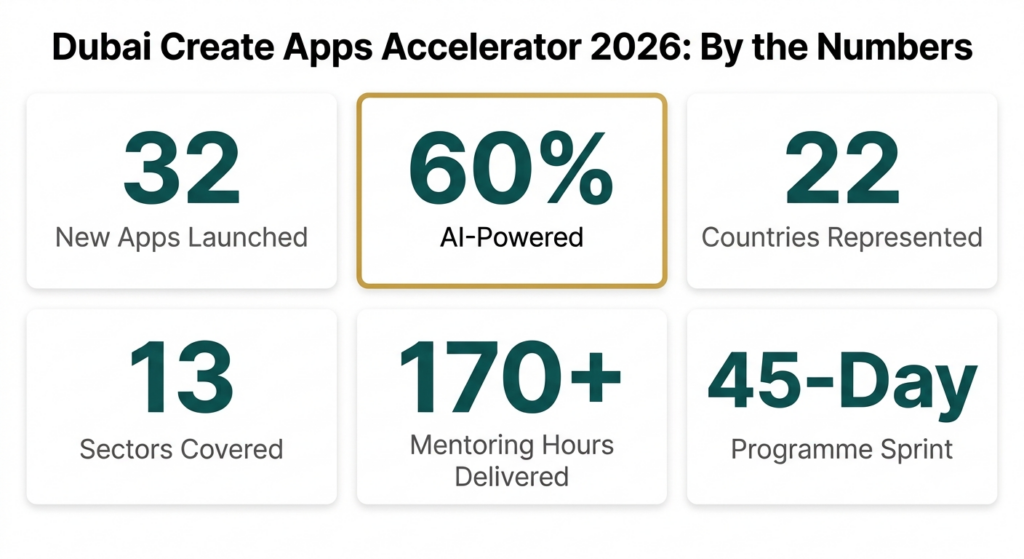
Its Create Apps Accelerator Programme supported the launch of 32 new mobile applications. 60% of those apps are AI-powered, built by founders from 22 countries across 13 sectors in a 45-day sprint. arabianbusiness
The number that matters most is not 32. It is 60%.
In 2026, AI app development is no longer an advantage for well-funded teams. It is the baseline expectation for Dubai’s startup market.
What does that mean for UAE founders, enterprises, and businesses that have not yet launched their AI-powered product? It means the competitive gap is widening in real time.
What the 60% AI App Figure Actually Signals for UAE Businesses
A 60% AI adoption rate among early-stage Dubai startups is not just a headline.
It is a market reset.
The Create Apps Accelerator Programme is designed specifically for founders who did not qualify for the final stages of the Create Apps Championship. These are not the most resourced teams in Dubai’s ecosystem. arabianbusiness
Yet 60% of their apps use AI.
AI chatbot apps, adaptive AI development features, and AI automation are the output of underfunded, early-stage teams in a 45-day sprint. Enterprises with larger teams and longer timelines have no technical excuse to lag.
80% of venture capital firms in the UAE are actively seeking AI-driven startups. Synergy Labs, December 2025
Not being AI-powered in 2026 is not a cost-saving decision. It is a positioning decision, and investors are watching.
Which Sectors Are Leading Dubai’s AI App Development Wave
This year’s programme brought together participants from 22 countries and 13 different sectors. Education emerged as one of the most strongly represented sectors, followed closely by healthcare and longevity. arabianbusiness
Five sectors define where the AI app momentum is concentrated.
Education (most represented sector): Personalized AI tutors, adaptive curriculum engines, and multilingual learning tools for the UAE’s diverse expat population.
Healthcare: In healthcare, diagnostic support apps, Arabic-language patient intake automation, and insurance pre-authorization via AI automation. DHA oversight applies in Dubai; DOH governs Abu Dhabi.
Fintech: AI chatbot development for customer onboarding, BNPL decisioning, and real-time fraud detection. The MENA fintech sector raised approximately $1.14 billion in 2025, representing 26% of all VC deal volume. Waveup, 2026
Social media and consumer apps: AI-powered discovery, personalized feed curation, and AI virtual companion features for the UAE’s under-35 digital population.
Real estate: For real estate, AI property-matching algorithms, virtual tour integrations, and automated pricing decision engines.
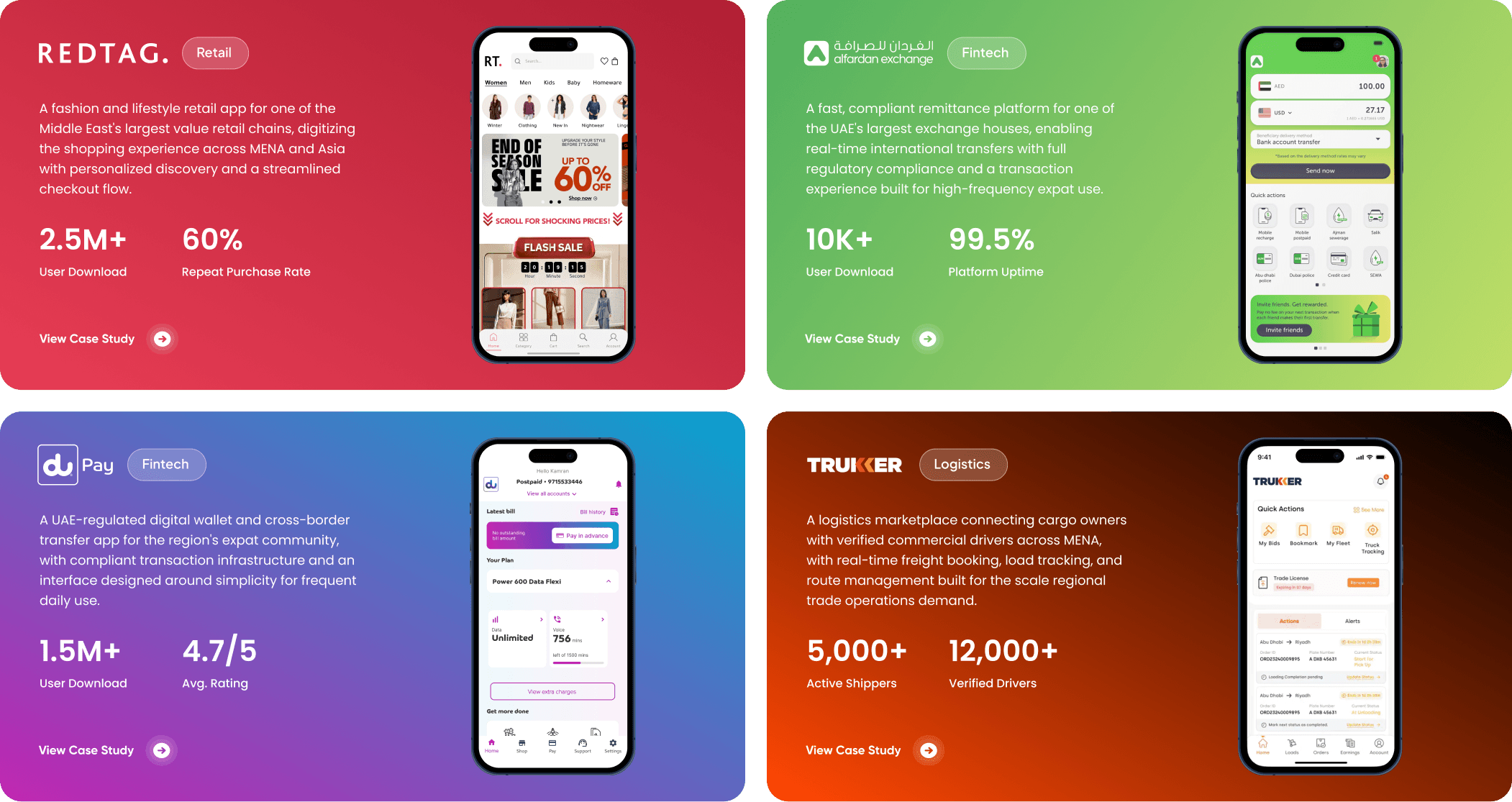
Code Brew Labs’ UAE portfolio covers four of these five sectors directly: Alfardan Exchange and duPay in fintech, REDTAG in retail, Trukker in logistics, and NMA in AI media.
Super Apps, AI Integration, and Where Dubai’s App Ecosystem Is Heading
32 individual app launches matter. The larger trajectory is consolidation.
UAE users prefer single digital platforms that handle multiple service categories. Super apps are the natural direction for Dubai’s AI app development curve.
Careem established the model: ride-hailing, food, payments, bikes, and home services on one platform. Talabat followed. Both run on AI integration layers that make cross-vertical personalization coherent.
As AI features become more accessible, Dubai founders are now building super app components that span fintech, logistics, education, and consumer services in parallel.
Adaptive AI development is what separates a super app that improves with usage from one that degrades six months after launch. Building the learning layer into the architecture from Day 1 is not optional at super app scale.
The best AI apps in the UAE are not just feature-rich. They accumulate user behavior data that makes the product harder to leave with every session.
UAE AI Strategy 2031: Why Dubai’s 60% Milestone Was Not Accidental
Dubai Chamber of Digital Economy’s accelerator executes a national strategy. The 60% AI figure is the startup market responding to that strategy in real time.
UAE AI Strategy 2031 targets AED 335 billion in AI-driven economic contribution. The target: AI represents 20% of non-oil GDP as per the UAE AI Office
The UAE has committed over $100 billion to AI investments. Synergylabs
The UAE Ministry of Economy launched a $500 million AI fund to support SMEs and early-stage companies integrating AI, combining capital with mentorship from global AI experts and scaling support. TRIBE TECHIE
Dubai-based companies captured 93% of the UAE’s H1 tech funding, a 133% jump over the prior half-year. WaveUp
Dubai’s 24-month agentic AI mandate requires private-sector businesses to adopt autonomous AI agents within this window. NomadX
Every instrument in this ecosystem, accelerators, funding, regulation, and mandates, points in the same direction. 60% AI adoption in the startup cohort is the startup market reading that signal correctly.
Curious about the top AI business opportunities for 2026? Watch our video:
How do UAE startups raise funding for AI apps in 2026?
Investors in 2026 are not funding AI features. They are funding AI-native business models with three measurable qualities.
Retention depth:
AI-driven personalization increases mobile app retention by up to 40%, per 2026 UX benchmarks. That metric is what differentiates a fundable MAU story from a standard one.
Lower cost per user at scale:
AI chatbot development and automation reduce support costs by 30 to 60% in UAE consumer apps. Lower support cost at scale is a margin story investors trust.
Data moat depth:
Every AI app that improves with usage accumulates proprietary training data. That data becomes a competitive barrier that new entrants cannot easily replicate.
CNTXT AI raised AED 220.35 million ($60 million) in a Series A from AI71 and BlueFive Capital in June 2026. The Arabic voice AI platform serves over 250 enterprises and 150,000 users. AnalyticsinsightAnalyticsinsight
Alaan, an AI-powered B2B fintech, raised a $48 million in Series A in August 2025, one of the largest Series A rounds in regional history. WaveUp
Both companies built production-grade AI architecture with measurable outcomes before they raised. That is the pattern of the UAE investors’ fund.
Code Brew Labs’ portfolio shows what fundable metrics look like in practice. GRINTAFY (2M+ downloads, 500K+ player profiles, 15+ countries) carries the data depth and international traction that growth-stage investors need to see. REDTAG (1M+ downloads, 35% increase in mobile revenue) provides the consumer retention and ROI story that justifies a Series A conversation.
Code Brew Labs: AI App Development Company and AI Consulting Partner for the UAE
Code Brew Labs is an AI mobile app development and AI consulting partner for UAE startups, enterprises, and government-connected ventures, shipping production-grade AI across aerospace, fintech, media, retail, logistics, sports, and automotive use cases.
From enterprise AI decision support for Airbus to CB UAE–compliant digital wallets and AI-powered retail super apps, our active UAE deployments show that AI integration is no longer experimental; it’s already transforming how businesses operate and grow in Dubai and across the region.
What UAE Founders and Enterprises Should Do After the Accelerator News
The Create Apps Accelerator produces market-ready apps. “Market-ready” and “scale-ready” are different stages with different architecture requirements.
Most AI apps built in short sprints face three structural gaps before reaching Series A readiness.
Gap 1: No MLOps foundation
AI apps degrade silently when the model’s behavior drifts from live user data. Monitoring and retraining triggers prevent this, but only if the architecture was designed to support them from Day 1.
Gap 2: No PDPL compliance layer
UAE PDPL compliance is mandatory by January 1, 2027. Building it from the first sprint costs AED 7,000 to 37,000. Retrofitting it post-launch costs 3 to 5 times more. WCR Legal
Gap 3: No Arabic-first design system
For UAE residents and government clients, Arabic RTL is a design requirement that affects navigation, QA, and government contract eligibility. It is not a post-launch localization task.
What is the difference between an AI app builder and an AI app development company?
An AI app builder is a no-code or low-code tool suited for prototypes and internal tools.
An AI app development company builds production-grade AI apps with compliance architecture, Arabic-first design, and MLOps foundations from the ground up. For UAE apps requiring PDPL, CBUAE, DHA, or DIFC compliance, only a development company provides the depth an app builder cannot deliver.
AI apps on Android and iOS are built cross-platform in 2026 with Flutter as the UAE standard frontend. It delivers native Arabic RTL support across both platforms from a single codebase. iOS market share in the UAE is approximately 55% versus 27% globally. Decipherzone, 2026
Code Brew Labs addresses all three production gaps from the first sprint, not as a post-launch audit.
Build an AI app backed by UAE production deployments
32 new apps. 60% AI-powered. Founders from 22 countries. One 45-day programme.
That is what Dubai’s Create Apps Accelerator produced in a single cohort in June 2026. The next cohort is already being planned.
The signal is not just about startups. UAE enterprises, government ventures, and growth-stage companies face the same competitive pressure: the standard for what a digital product must do in 2026 has shifted, and the shift is not reversing.
The gap between a market-ready AI app and a scale-ready, funding-eligible, PDPL-compliant one is where most UAE projects fail. Code Brew Labs has closed that gap across eight production deployments in the UAE’s priority sectors.
FAQs:
Q1: What was the Dubai Chamber of Digital Economy’s Create Apps Accelerator Programme?
The Create Apps Accelerator Programme is a 45-day technology sprint run by the Dubai Chamber of Digital Economy. It helps startup founders transform app ideas into market-ready products through mentoring, workshops, and compliance guidance. The June 2026 cohort supported 32 app launches from 22 countries across 13 sectors, with 60% of apps using AI. The programme delivered 170+ hours of mentoring and 6 specialized workshops.
Q2: Why are 60% of new Dubai startup apps AI-powered?
The 60% figure reflects the startup market responding to UAE AI Strategy 2031 and its accompanying policy instruments: a $500M AI fund, the Stargate UAE infrastructure, and a 24-month agentic AI mandate for private-sector adoption. In 2026, building a digital product without AI is a market positioning disadvantage, not a cost-saving decision. (Sources: UAE AI Office, Tribe Techie April 2026, NomadX 2026)
Q3: How do AI apps help UAE startups raise funding in 2026?
UAE investors in 2026 look for three qualities in AI apps: retention depth (AI personalization increases retention by up to 40%), reduced support cost at scale (AI chatbot development cuts support cost by 30 to 60%), and data moat depth (proprietary training data accumulated with every user session). Platforms like GRINTAFY (2M+ downloads, 500K+ player profiles) and REDTAG (1M+ downloads, 60% repeat purchase rate) demonstrate the outcomes that create fundable growth stories.
Q4: What is adaptive AI development, and why does it matter for UAE app builders?
Adaptive AI development refers to building apps that improve continuously with usage through model learning, rather than operating on static logic. For UAE apps targeting a 95% mobile internet penetration market (GSMA 2025), adaptive AI is what maintains product accuracy and user retention as behavior evolves. Without it, AI features degrade after launch and require costly rebuilds at the worst possible stage: after a funding round.
Q6: What is the difference between AI consulting and AI app development in the UAE?
AI consulting identifies where AI creates measurable business value: which workflows to automate, which data assets to use, and which compliance requirements apply before code is written. AI app development builds the production product from that foundation. Code Brew Labs provides both AI consulting for strategy and architecture decisions, and full AI app development for production builds across the UAE’s regulated sectors.
Let's Convert Your Business Idea Into Success!
Free Consultation from Top Industry Experts
Let’s Build Your Dream App!
Share article on :


 No commitment required
 NDA on request
 24-hour response