DHA, MOHAP and DOH Readiness
HL7 and FHIR Based Interoperability
Arabic and English Healthcare UX
DHA, MOHAP and DOH Readiness
HL7 and FHIR Based Interoperability
Arabic and English Healthcare UX
 DHA, MOHAP and DOH Readiness
HL7 and FHIR Based Interoperability
Arabic and English Healthcare UX
DHA, MOHAP and DOH Readiness
HL7 and FHIR Based Interoperability
Arabic and English Healthcare UX









Years of Experience
Solutions Delivered
Industries Served
Technology Specialists
Every product we build is scoped against UAE healthcare regulations from day one.
We map your workflows, plan your integrations, and design for Arabic and English users.

We scope Dubai Health Authority and Ministry of Health and Prevention requirements into your project plan before development starts. This reduces late-stage compliance risk before launch

We plan integrations with NABIDH (Dubai), Malaffi (Abu Dhabi), and Riayati (other emirates) during the discovery phase, so your app is prepared to connect with the National Unified Medical Record where applicable.

We build data exchange on HL7 and FHIR standards so your app communicates with hospitals, labs, pharmacies, and insurance systems without middleware workarounds.

Our UX team designs right-to-left Arabic flows alongside English, covering font rendering, form inputs, date formats, and clinical content localization.

We apply role-based access control, consent management, audit logging, and encrypted storage from the architecture stage, aligned with UAE PDPL and applicable healthcare data standards.

We integrate AI modules for symptom checking, clinical decision support, patient triage, and care pathway automation, built for UAE clinical environments.
Each service is outcome-led. As a healthcare app development company in UAE, we scope, design, build, and support healthcare apps that work inside UAE clinical and regulatory environments.


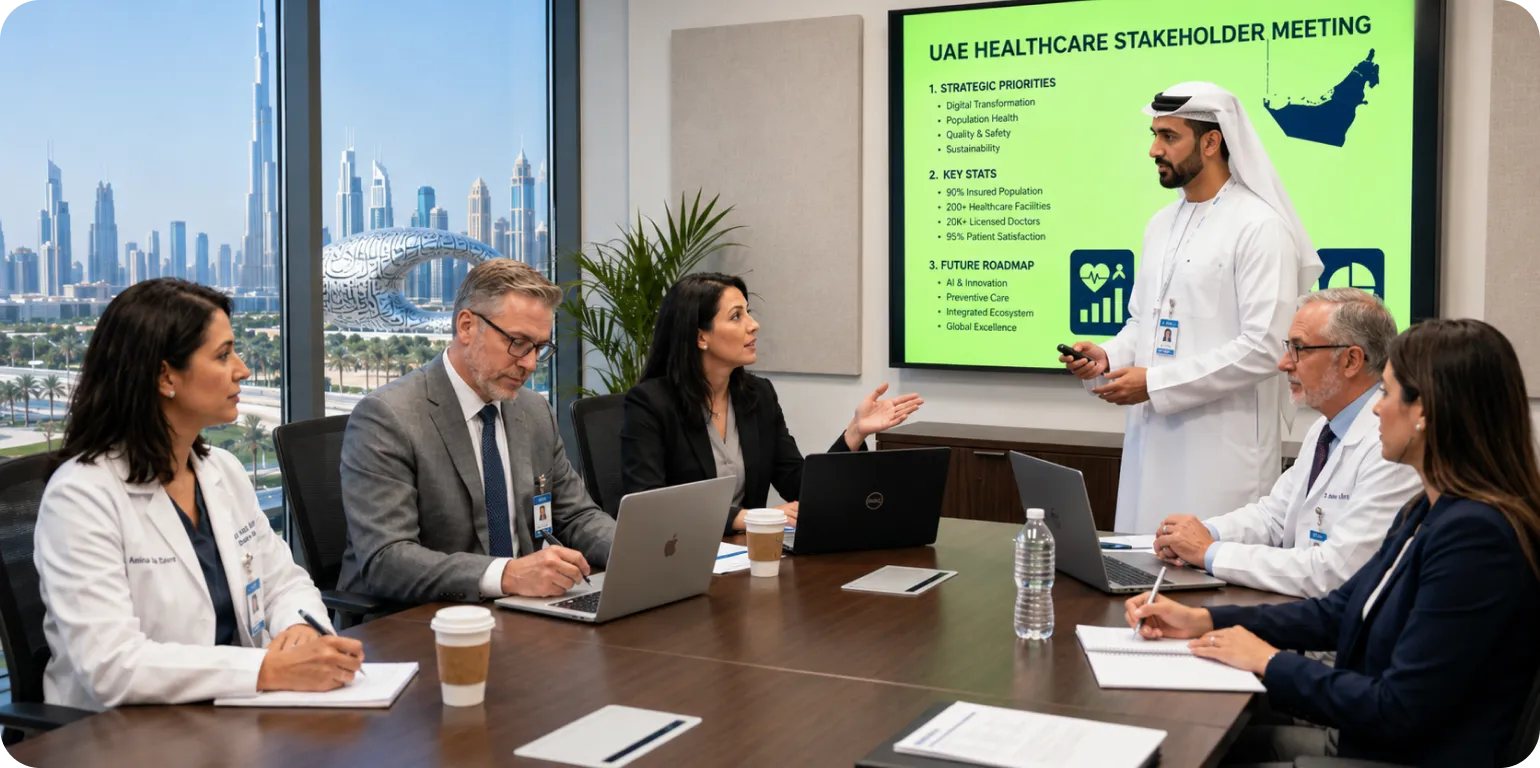


Full-stack hospital management apps covering inpatient care, outpatient scheduling, bed occupancy, clinical documentation, insurance billing, and NABIDH/Malaffi connectivity.


Trained on validated clinical data, the symptom checker helps patients self-triage and routes them to the right care level, reducing unnecessary emergency visits.

Real-time treatment suggestions, drug interaction alerts, and diagnostic support tools integrated into the doctor workflow, without replacing clinical judgment.

Continuous vital data collection from wearables and connected devices, with threshold-based alerts sent to care teams for chronic disease and post-surgical patients.

We connect apps to FDA-cleared and CE-marked wearables including blood glucose monitors, ECG patches, pulse oximeters, and smartwatches for real-time health data.

Bidirectional data sync with hospital EHR and EMR systems using HL7 and FHIR standards, supporting NABIDH, Malaffi, and Riayati where applicable.

Digital prescription generation, pharmacy routing, patient notification, and dispensing confirmation, with audit trail for compliance.

Pre-authorization, claims submission, adjudication tracking, and payment reconciliation integrated with UAE insurance providers and TPAs.

Patient outcome tracking, appointment utilisation, revenue analytics, clinical workflow performance, and compliance reporting for administrators and clinical leads.
We scope compliance requirements before writing a single line of code. Every app is planned around applicable UAE healthcare data, security, and operational requirements.





Off-the-shelf solutions rarely account for UAE compliance requirements, Arabic UX, or local health information exchange connectivity. Custom apps close those gaps.
Patients across Dubai, Abu Dhabi, and other emirates often have records spread across multiple providers with no unified view. Custom apps with NABIDH, Malaffi, and Riayati integration support continuity of care.
Manual scheduling, SMS reminders, and paper follow-up processes create bottlenecks and increase no-shows. Automated workflows inside a custom app reduce administrative load and improve patient attendance.
Using generic platforms not built for UAE healthcare exposes providers to UAE PDPL, DHA, and MOHAP compliance gaps. Custom apps built to local standards reduce that risk from the start.
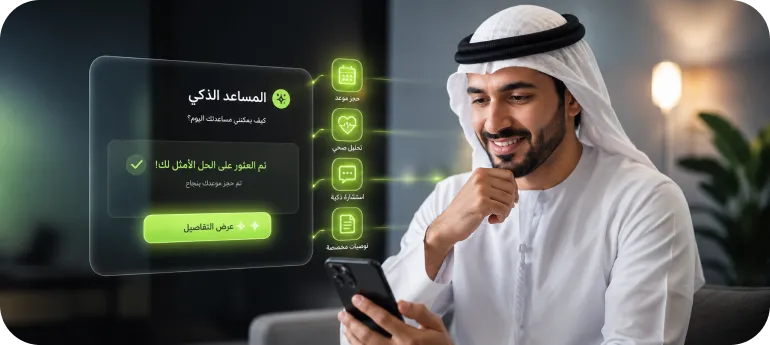
Healthcare users in UAE include Arabic speakers, English speakers, and South Asian communities. A patient app that handles Arabic RTL, English, and clear bilingual content reduces friction and improves adherence.
Care quality breaks down when providers cannot share data with labs, pharmacies, or insurance systems. Custom apps with HL7 and FHIR integration close the operational loop.

We map DHA, MOHAP, DOH, and UAE PDPL requirements in the discovery sprint, not after launch. Compliance is designed in, not added on.
Encrypted data storage, role-based access, consent management, and audit logging are built into the architecture from day one.
We plan connectivity with NABIDH, Malaffi, Riayati, and third-party EHR systems before development starts, using HL7 and FHIR as the exchange standards.
Our UX team builds fully bilingual interfaces with Arabic RTL support, clinical content localisation, and culturally appropriate patient-facing design.
Appointment flows, follow-up sequences, prescription routing, lab result delivery, and insurance pre-authorisation are automated to reduce manual work for clinical staff.
Clients receive full source code on project handoff. Post-launch support is included, covering bug fixes, OS updates, and feature iterations.

We map DHA, MOHAP, DOH, and UAE PDPL requirements in the discovery sprint, not after launch. Compliance is designed in, not added on.
Encrypted data storage, role-based access, consent management, and audit logging are built into the architecture from day one.
We plan connectivity with NABIDH, Malaffi, Riayati, and third-party EHR systems before development starts, using HL7 and FHIR as the exchange standards.
Our UX team builds fully bilingual interfaces with Arabic RTL support, clinical content localisation, and culturally appropriate patient-facing design.
Appointment flows, follow-up sequences, prescription routing, lab result delivery, and insurance pre-authorisation are automated to reduce manual work for clinical staff.
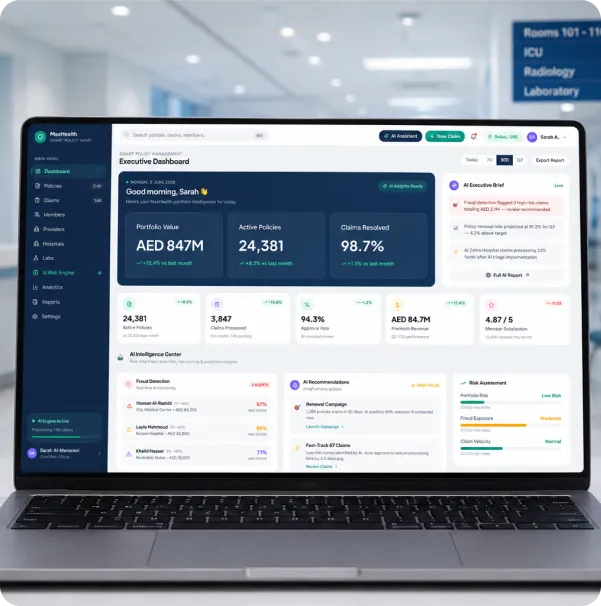
The client faced major operational friction with manual healthcare policy issuance, high administrative claim handling costs, and prolonged verification workflows that delayed customer processing.
The client faced major operational friction with manual healthcare policy issuance, high administrative claim handling costs, and prolonged verification workflows that delayed customer processing.
Faster Listing Updates
Faster Listing Updates
Healthcare app development cost in UAE depends on a range of technical and compliance factors. There is no standard price because no two healthcare apps have identical requirements.
Telemedicine, patient portal, hospital management, or pharmacy app each carry different scope
Patient, doctor, admin, pharmacy, lab, and super admin panels increase scope and cost
NABIDH, Malaffi, EHR, lab, pharmacy, and insurance connectivity
DHA, MOHAP, DOH, UAE PDPL, and applicable data standards
Symptom checkers, clinical decision support, and remote monitoring modules
Bilingual design, RTL implementation, and clinical content localisation
iOS only, Android only, or cross-platform with web portal

We provide detailed cost estimates after a free discovery call where we scope your requirements properly.


Healthcare mobile app development in UAE refers to the design, build, and deployment of mobile applications for hospitals, clinics, telemedicine providers, pharmacies, labs, and health startups operating in the UAE. These apps must align with DHA, MOHAP, and DOH regulations, support Arabic and English, and where applicable connect with NABIDH, Malaffi, and Riayati.
Cost varies depending on app type, number of user panels, healthcare integrations, compliance requirements, AI features, and platform scope. A focused patient portal is budgeted differently from a full-stack hospital management platform. Request a scoped estimate for your specific project.
A focused single-panel app typically takes three to five months. Multi-panel platforms with EHR integration and compliance scoping take six to twelve months. Timeline depends on feature scope, integration complexity, and testing requirements.
The primary standards are DHA (Dubai Health Authority), DOH Abu Dhabi (Department of Health Abu Dhabi), MOHAP (Ministry of Health and Prevention), and UAE PDPL (Personal Data Protection Law). For data exchange, NABIDH, Malaffi, and Riayati connectivity, and HL7/FHIR interoperability standards are relevant for most UAE healthcare apps.
Yes. We plan NABIDH, Malaffi, and Riayati integration during the discovery phase. Integration scope and timeline depend on the applicable emirate-level HIE and your provider registration status with the relevant health authority.
Yes. Arabic is an official language of the UAE and a significant portion of patients prefer Arabic as their primary interface language. We build full Arabic RTL support with clinical content localisation alongside English in all patient-facing apps.
A patient app for the UAE market should include appointment booking, video consultation, prescription history, lab results, medication reminders, insurance card access, UAE Pass sign-in support, and bilingual Arabic and English interfaces.
Yes. We build telemedicine platforms covering video consultations, asynchronous messaging, e-prescriptions, appointment management, and DHA-aligned telemedicine operational design for UAE-registered providers and startups.
Yes. We build bidirectional data integrations with EHR and EMR systems, diagnostic lab platforms, pharmacy management systems, and insurance providers using HL7 FHIR R4 and applicable UAE HIE standards.
Yes. Every client receives full source code ownership on project completion. There are no ongoing licence fees or platform lock-in from Code Brew Labs.
Yes. Post-launch support is included, covering bug fixes, OS compatibility updates, security patches, and feature iteration roadmaps.
Code Brew Labs builds healthcare mobile apps, telemedicine platforms, patient portals, hospital dashboards, and healthcare software for UAE providers with DHA, MOHAP, DOH, HL7/FHIR, Arabic UX, and EHR integration planning.
We’ve got more answers waiting for you! If your question didn’t make the list, don’t hesitate to reach
Tell us what you are working on. Whether you are starting from scratch or improving something that already exists, we will give you a clear plan and a straight answer on what it takes.
 No commitment required
 NDA on request
 24-hour response

Let's align our constellations! Reach out and let the magic of collaboration illuminate our skies.