CBUAE and UAE Fintech Readiness Planning
KYC, AML and PCI DSS Architecture Support
Open Finance and Banking API Integration
CBUAE and UAE Fintech Readiness Planning
KYC, AML and PCI DSS Architecture Support
Open Finance and Banking API Integration
 CBUAE and UAE Fintech Readiness Planning
KYC, AML and PCI DSS Architecture Support
Open Finance and Banking API Integration
CBUAE and UAE Fintech Readiness Planning
KYC, AML and PCI DSS Architecture Support
Open Finance and Banking API Integration
Years of Experience
Solutions Delivered
Industries Served
Technology Specialists

We scope your product architecture with CBUAE, DFSA, FSRA, and VARA frameworks in mind from day one. Regulatory planning is part of discovery, not an afterthought.

We design eKYC flows, identity verification pipelines, and AML screening integrations that support faster user onboarding without compromising due diligence.

Card payment flows, tokenisation, and transaction handling are architected with PCI DSS compliance planning built into the payment layer from the ground up.

We integrate Open Finance APIs, core banking connectors, payment gateway SDKs, and machine learning financial software integrations so your app connects to the financial infrastructure UAE users expect.

AI-driven fraud scoring, real-time transaction monitoring, and configurable alert thresholds help you manage risk without adding friction to genuine transactions.

Every interface is designed for both Arabic RTL and English users, with language-aware layouts, currency formatting, and accessibility standards applied throughout.


MVP planning, investor-ready product architecture, scalable backend infrastructure, AI-powered financial platform development, and go-to-market speed for fintech startups launching in Dubai and the wider UAE.




Automated identity verification, liveness detection, document OCR, and digital onboarding flows that reduce drop-off while meeting KYC AML automated workflow integration requirements.

Fingerprint, face ID, and voice recognition authentication layers that meet financial-grade security requirements without adding friction to the user experience.

Machine learning models trained on transaction patterns to flag anomalies, score risk in real time, and reduce false positives across payment and transfer flows.

Automated monitoring of payment flows with configurable thresholds, alert routing, and case management tools built for compliance team workflows.

Account aggregation, payment initiation, and data sharing via Open Finance APIs aligned with the UAE Central Bank Open Finance framework.

Integration with leading UAE and regional payment gateways, PCI DSS compliant payment gateway infrastructure, card scheme networks, and merchant acquiring platforms for complete payment infrastructure coverage.

Multi-currency wallet architecture, internal ledger management, float controls, and real-time balance reconciliation for stored value products.

End-of-day settlement automation, multi-party reconciliation workflows, and exception handling to reduce manual finance operations overhead.

Alternative data credit scoring, behavioural risk models, and lending decision engines for digital lending and BNPL platforms.

Goal-based portfolio construction, rebalancing algorithms, risk profiling questionnaires, and investment performance dashboards for wealthtech products.

Real-time revenue reporting, cohort analysis, transaction volume tracking, and product performance dashboards for internal teams.

Push notifications, SMS alerts, and in-app messaging for payment confirmations, security events, account activity, and compliance actions.
We approach compliance planning as an architecture decision. These are the frameworks and standards we incorporate into product scoping, design, and development.















Off-the-shelf solutions rarely account for UAE compliance requirements, Arabic UX, or local health information exchange connectivity. Custom apps close those gaps.
Lengthy KYC processes, manual document collection, and multi-step verification push users away before they complete registration. Competitors with faster onboarding capture the business first.
Many UAE financial products are built without proper banking API, open finance, or payment gateway integration. The result is manual workarounds, reconciliation errors, and limited payment acceptance.
Fintech products without real-time fraud detection, transaction monitoring, and AML screening carry material risk exposure. Regulators and banking partners increasingly require demonstrable controls.
The UAE regulatory environment is evolving quickly. CBUAE, DFSA, FSRA, VARA, and UAE PDPL each carry obligations. Products built without compliance planning in the architecture phase face expensive retrofits.
Financial users make decisions based on trust. Apps with weak security signalling, unclear data handling, or inconsistent UX across Arabic and English interfaces lose users before conversion.


We map relevant regulatory frameworks to your product type in discovery. KYC, AML, CBUAE, DFSA, VARA, and PCI DSS considerations are built into the architecture before a single line of code is written.
Payment flows, wallet operations, and data handling are designed with AES-256 encryption, token-based authentication, RBAC, and audit logging as standard components.
We integrate eKYC APIs, AML screening services, and transaction monitoring tools into onboarding and payment flows so your compliance team has the data they need from launch.
We connect your product to core banking systems, UAE and regional payment gateways, card issuing APIs, and Open Finance infrastructure for full financial service coverage.
Every screen is designed for both language contexts. RTL layout, locale-aware number formatting, and bilingual content management are built into our design and development process.
You own the codebase. We deliver complete source code, documentation, and post-launch support plans that cover bug fixes, security updates, and feature iteration.

We map relevant regulatory frameworks to your product type in discovery. KYC, AML, CBUAE, DFSA, VARA, and PCI DSS considerations are built into the architecture before a single line of code is written.
Payment flows, wallet operations, and data handling are designed with AES-256 encryption, token-based authentication, RBAC, and audit logging as standard components.
We integrate eKYC APIs, AML screening services, and transaction monitoring tools into onboarding and payment flows so your compliance team has the data they need from launch.
We connect your product to core banking systems, UAE and regional payment gateways, card issuing APIs, and Open Finance infrastructure for full financial service coverage.
Every screen is designed for both language contexts. RTL layout, locale-aware number formatting, and bilingual content management are built into our design and development process.
You own the codebase. We deliver complete source code, documentation, and post-launch support plans that cover bug fixes, security updates, and feature iteration.
"What I found most impressive about Code Brew Labs is their holistic approach to understanding and solving the specific needs of our business. They didn't just provide us with a one-size-fits-all solution; instead, they took the time to delve deeply into our unique challenges and objectives. This bespoke approach led to the development of a fintech solution that was perfectly tailored to our requirements.

"Their work in developing complex features like custom APIs, blockchain infrastructure, and secure payment gateways highlights their strong technical capabilities. Code Brew Labs delivered a stable, scalable platform that met our expectations perfectly. The team was highly proactive, responsive, and timely, providing regular updates and reviews that kept the project aligned with our business goals."

"They are a great partner to work with in terms of meeting all of our needs and being highly flexible. Their customer services are something that really makes them different—they are very accommodating and work as your true strategic partners and not just a standard development company. They maintained transparent communication channels and kept us updated at every single stage."

Our fintech app portfolio covers digital wallets, payment platforms, lending apps, banking software, AI-powered fintech solutions, and investment platforms delivered for clients across the UAE and international markets.
A growing financial institution required a secure digital banking platform capable of eliminating manual auditing gaps, reducing cross-border transaction risks, and accelerating real-time payment processing without disrupting its existing core banking infrastructure.
Code Brew Labs engineered and deployed a custom fintech software solution built on its proprietary TMX Agentic Finance platform. The architecture incorporated a dedicated Chaincode Layer on Hyperledger Fabric for automated payment validation, a real-time Wallet Service for balance management, a predictive Risk API for transaction verification, and automated Redis Session States that supplied contextual intelligence to the platform’s AI-powered fraud detection engine.
Payment processing speeds
Increased overall conversion rates
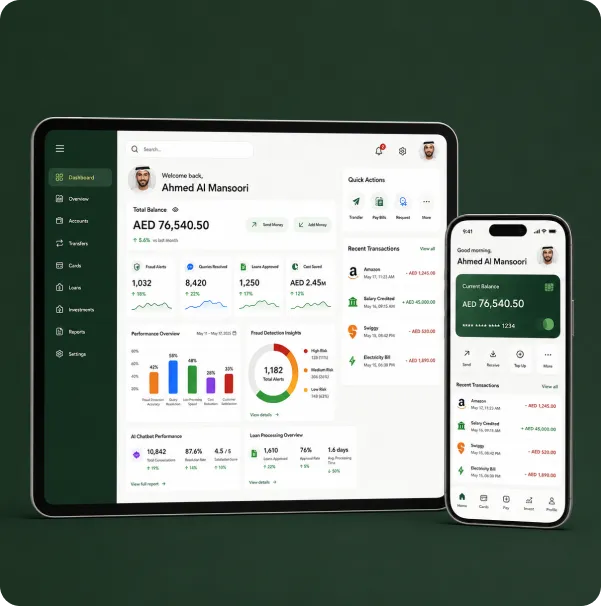
Fintech app development cost in the UAE varies based on the product type, feature depth, compliance scope, and integration requirements. Here are the main factors that shape your estimate.
A digital wallet MVP, a full-service neobank platform, a lending app, and a trading platform each carry different complexity levels. The product category is the primary cost driver.
Each panel adds design, development, and testing scope. Products with customer, merchant, agent, admin, compliance, and super admin tiers cost more than single-panel apps.
Payment gateway integration, core banking API connection, card issuing, and Open Finance API work each add scope. The number and complexity of integrations materially affects the budget.
eKYC API integration, document verification, liveness detection, and AML screening services add cost relative to the depth of compliance coverage required.
PCI DSS payment security planning, ISO 27001-aligned architecture, VAPT testing, and consent management features add scope that varies by your regulatory obligations.
Custom ML models for fraud scoring, credit risk, and transaction monitoring are more expensive than off-the-shelf API integrations. Scope depends on the accuracy and latency requirements.
Full bilingual UX with RTL support, locale-aware content management, and Arabic typography adds design and development effort relative to single-language products.
iOS only, Android only, cross-platform mobile, and web dashboard combinations each carry different build scopes. Backend complexity and cloud infrastructure also factor in.

A focused MVP targeting one user panel and core payment flow can be scoped and launched faster. Enterprise products with multi-entity support, advanced analytics, and deep integrations carry longer timelines and higher budgets.


Fintech app development is the process of designing and building software applications for financial services. This includes digital wallets, banking apps, payment platforms, lending tools, investment apps, insurance products, and compliance software. Fintech apps handle sensitive financial data and transactions, so security, regulatory awareness, and UX are core concerns throughout the build.
Building a fintech app starts with product discovery, regulatory scoping, and architecture planning. The team designs financial UX flows, plans third-party integrations such as KYC APIs and payment gateways, then builds and tests the product across security, compliance, and performance requirements before launching and supporting it post-release.
The four commonly referenced pillars of fintech are payments, lending, investment, and insurance. Modern fintech apps often span several of these areas, particularly super apps, neobanks, and embedded finance platforms that combine multiple financial services in a single product.
Examples include digital wallets such as Apple Pay and regional equivalents, neobanking apps, BNPL platforms, peer-to-peer lending apps, robo-advisory investment tools, crypto exchange apps, insurtech claim management platforms, and embedded payment features inside marketplace and super apps.
Fintech app development cost in the UAE depends on the product type, number of user panels, integration scope, compliance requirements, and platform coverage. A focused MVP with one user panel and core payment features costs significantly less than a multi-panel neobank platform with full compliance architecture. Contact Code Brew Labs for a scoped project estimate.
A focused fintech MVP typically takes between three and six months depending on feature scope and integration complexity. A full-featured neobank, lending platform, or investment app with multiple panels and deep integrations can take nine to eighteen months or more. Timeline is driven by compliance scope, number of integrations, and user panel count.
Key frameworks include CBUAE regulations covering retail payment services, stored value facilities, and Open Finance. DFSA and FSRA apply for DIFC and ADGM-regulated businesses. VARA applies to virtual asset service providers. KYC, AML, and CTF obligations apply across financial products. PCI DSS governs card payment handling. UAE PDPL applies to personal data processing. Code Brew Labs builds compliance planning into the architecture phase; clients should seek qualified legal advice for licensing and regulatory authorisation.
Yes. We build digital wallet apps for UAE startups, payment service providers, and enterprises including stored value facility products, multi-currency wallets, QR payment apps, and peer-to-peer transfer platforms with full payment gateway and banking API integration.
Yes. Our fintech app development services include digital banking apps, neobank platforms, loan management and lending apps, BNPL platforms, payment aggregation apps, and remittance products for the UAE and GCC markets.
Yes. We integrate leading eKYC providers, AML screening APIs, regional and international payment gateways, Open Finance APIs, and core banking connectors. Integration planning happens in the discovery phase so there are no surprises during development.
Arabic support is important for UAE market reach, particularly for consumer-facing products. We design and build both Arabic RTL and English interfaces, with locale-aware layouts, proper typography, and bilingual content management to ensure a consistent experience across language contexts.
Yes. Code Brew Labs delivers the complete source code, technical documentation, and repository access to every client. You own your product fully with no lock-in to our team for future development.
Yes. We offer post-launch support covering bug fixes, security patches, performance monitoring, platform updates, and feature development. Support plans are agreed as part of the project scope to ensure continuity after launch.
We’ve got more answers waiting for you! If your question didn’t make the list, don’t hesitate to reach
Tell us what you are working on. Whether you are starting from scratch or improving something that already exists, we will give you a clear plan and a straight answer on what it takes.
 No commitment required
 NDA on request
 24-hour response

Let's align our constellations! Reach out and let the magic of collaboration illuminate our skies.