Quick Summary:
- Mobile app development costs in Dubai range from AED 18,000 to AED 1,470,000+, depending on the scope and compliance requirements.
- Most mid-level UAE business apps land between AED 92,000 and AED 294,000, including design and backend.
- Cross-platform app development with Flutter or React Native cuts build cost by 35–40% versus separate native iOS and Android builds.
- UAE-specific compliance (PDPL, Arabic RTL, TDRA) adds 15–30% to the project cost that most quotes exclude upfront.
- Annual maintenance averages 15–25% of the initial build cost. Budget for this before the project begins, not after launch.
- AI features (bilingual chatbots, personalization, fraud detection) now add $8,000–$80,000+ to any Dubai app build, depending on type and complexity.
- Total Year 1 cost of ownership typically runs 1.5 to 2x the development quote once hosting, marketing, and compliance are included.
- Code Brew Labs has delivered 2,600+ custom mobile apps across Dubai, Abu Dhabi, and the GCC with verified client outcomes.
As per Horizon Databook, the UAE mobile app market generated USD 1.34 billion in 2024 and is projected to reach USD 2.36 billion by 2030.
The internet penetration in the UAE stands at 99% of the total population, per DataReportal Digital 2026.
Decision-makers understand the market case. What most underestimate is what a competitive, compliant, Arabic-bilingual mobile app actually costs to build and run.
The standard quote a business receives covers the build. It rarely accounts for UAE regulatory compliance, Arabic RTL redesign, or regional payment gateway integrations.
It also rarely accounts for the three OS updates that arrive before the app turns six months old. That gap between the quote and the full economic picture is where most Dubai app projects exceed budget.
This blog gives the complete cost picture: build, compliance, AI features, post-launch obligations, and a Total Cost of Ownership model drawn from real UAE app projects.
Whether you are a startup founder in DIFC, a procurement head at a government entity, or a digital lead at a GCC enterprise, you will leave with the numbers and the framework to budget correctly.
Watch our video:
How Much Does Mobile App Development Cost in Dubai?
Building a mobile app in Dubai costs between AED 18,000 ($5,000) for a basic MVP and AED 1,470,000+ ($400,000+) for a complex enterprise platform with full UAE compliance, AI functionality, and multi-tenant architecture.
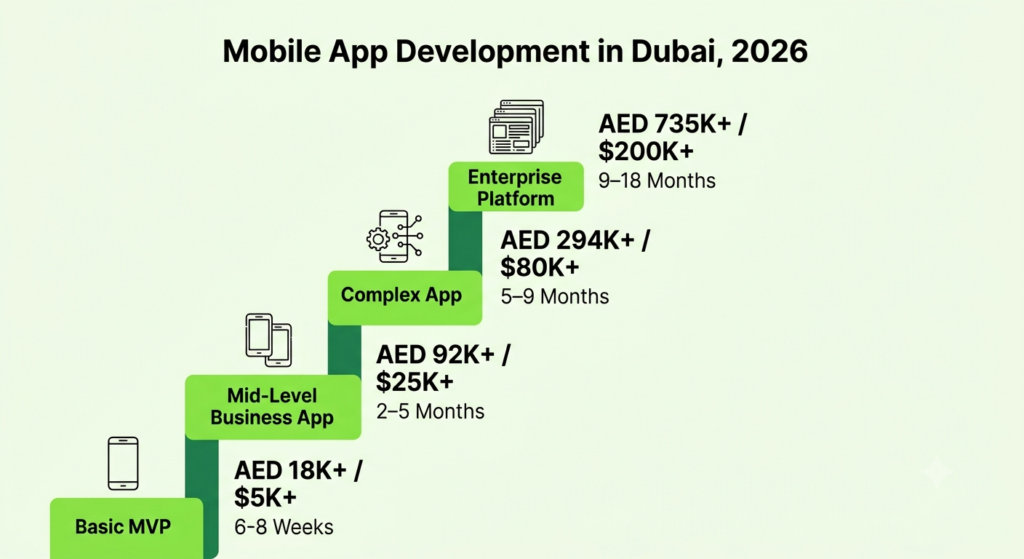
The range is not ambiguous. It is the real spread between a market-test MVP and an enterprise platform serving thousands of daily users.
Most mid-level cross-platform business apps in Dubai cost between AED 92,000 and AED 294,000.
Mobile App Development Cost in Dubai — By Tier (2026)
| App Tier | Estimated Cost (AED) | Timeline | What Is Included |
| Basic MVP | AED 18K–92K / $5K–$25K | 6-8
weeks |
3–5 screens, single platform, login, push notifications, basic backend |
| Mid-Level Business App | AED 92K–294K / $25K–$80K | 2–5 months | Cross-platform iOS + Android, 8–15 screens, payment gateway, Arabic RTL |
| Complex App | AED 294K–735K / $80K–$200K | 5–9 months | 20+ screens, real-time data, AI features, CRM integration, multi-user roles |
| Enterprise Platform | AED 735K–1.47M+ / $200K–$400K+ | 9–18 months | Microservices, full UAE compliance, AI/ML, custom integrations, admin ecosystem |
These figures reflect the build cost only. The total cost of running a mobile product in the UAE includes compliance, maintenance, and marketing.
Want a free scoped cost estimate for your mobile app?
What Makes Dubai Mobile App Development Different from Every Other Market?
Dubai is commercially attractive and operationally specific. A mobile app built without UAE requirements factored in from day one is not a Dubai app.
It is a generic app that will need expensive remediation before it can serve the market it was built for.
Dubai Economic Agenda D33 and What It Means for Mobile App Developers
Launched in January 2023, the Dubai Economic Agenda D33 targets AED 32 trillion in cumulative GDP by 2033. It sets a goal of AED 100 billion annual contribution from digital transformation projects. UAE Government — Dubai Economic Agenda D33
Government entities across Dubai face active pressure to digitize processes. This creates procurement timelines and compliance requirements distinct from private-sector builds.
Apps serving government bodies, RTA (Roads and Transport Authority), DEWA, MOHRE, carry additional compliance and integration obligations. These are not optional extras. They are entry requirements.
UAE PDPL Compliance — The Cost Nobody Quotes Upfront
Federal Decree-Law No. 45 of 2021 (UAE PDPL) requires data consent mechanisms, deletion protocols, breach notification procedures, and data residency documentation.
Non-compliance carries financial penalties between AED 50,000 and AED 5 million, enforced by the UAE Data Office. Middle East Briefing — UAE Data Protection Obligations, July 2025
PDPL compliance built from sprint one adds AED 15,000–30,000 to the project cost. The same work retrofitted post-launch costs three to five times more.
Regulated sectors, fintech, healthcare, and government, carry sectoral compliance on top of federal PDPL.
Arabic RTL — A Layout Architecture Decision, Not a Translation Task
Arabic is the official language of the UAE. RTL (right-to-left) layout is the expected standard for government, enterprise, and consumer-facing apps.
True Arabic localization requires mirroring every navigation flow, flipping icon placements, redesigning form inputs, and running a separate Arabic QA cycle.
This adds 15–25% to design cost and 8–15% to development hours. Content translation and cultural review add AED 7,000–30,000, depending on content volume.
UAE Pass, Emirates ID, and the Payment Ecosystem
UAE Pass is the national digital identity platform, operated by TDRA (Telecommunications and Digital Government Regulatory Authority). Integration requires formal TDRA approval and adds AED 15,000–30,000 to the build cost.
For e-commerce apps, a complete UAE payment stack includes: PayTabs or Telr as the primary gateway, Noon Pay or Network International for enterprise, Tabby and Tamara for BNPL, and Apple Pay and Samsung Pay for wallet transactions.
Each payment gateway integration adds $3,000–8,000 in development cost plus $50–300/month in ongoing subscription fees.
Regional payment requirements:
| Gateway | Category | Estimated Added Build Cost |
| PayTabs, Telr | Primary commerce | AED 11,000–29,000 per gateway |
| Noon Pay, Network International | Enterprise/banking | AED 11,000–29,000 per gateway |
| Tabby, Tamara | Buy-now-pay-later (BNPL) | AED 11,000–29,000 per gateway |
| Apple Pay, Samsung Pay | Device wallets | AED 7,000–15,000 per gateway |
Apps that skip BNPL lose conversion from a high-spending demographic that expects split-payment as a default.
Free Zones and Compliance Jurisdiction (DIFC, DMCC, Dubai Internet City)
Apps operated by DIFC-licensed entities fall under DIFC Data Protection Law No. 5 of 2020, not the federal PDPL. These are distinct frameworks with separate enforcement bodies. Guide to Data Protection and Privacy Laws in UAE, 2025
Enterprise and Fortune 500 regional HQs, often operating from DIFC or Dubai Internet City, must meet both federal and free zone compliance requirements simultaneously. Budget AED 30,000–80,000 extra for this dual compliance architecture versus an equivalent-scope private app.
The 10 Cost Drivers That Determine Mobile App Development Cost
The range from AED 18,000 to AED 1,470,000 is driven by ten variables. Understanding which ones apply moves the estimate from a range to a number.

1. App Complexity and Feature Scope
Complexity is the dominant cost driver. A login screen adds two days of development time. A real-time GPS tracking system adds four to six weeks.
More features create exponentially more testing cycles, not just linearly more development time.
Scope creep mid-project adds 30–50% to the final cost. Lock the feature list before sprint one begins.
2. Platform: iOS, Android, or Cross-Platform
Single native builds limit market reach. Dual native development costs 25–45% more but delivers full platform-level optimization.
Flutter saves 35–40% on build cost versus separate native iOS and Android development. Primocys — Why Flutter is the Best Cross-Platform Framework in 2026
Use native only when deep hardware access is required: advanced AR, biometric sensor integration. For service apps, cross-platform is the default choice.
3. UI/UX Design Including Arabic RTL
Consumer apps targeting Dubai demographics need 15–25% of the total budget allocated to design. Enterprise tools can work with 10–15%.
Arabic RTL requires a full second design pass and a separate QA cycle. Basic standard design: AED 5,000–15,000. Custom bilingual consumer app design with high-fidelity animation: AED 40,000–80,000.
4. Backend Infrastructure and UAE Data Residency
PDPL and enterprise client requirements increasingly mandate data residency within the UAE or GCC.
AWS Middle East (Bahrain) and Azure UAE North are the two primary compliant cloud options. Moro Hub provides UAE-sovereign hosting for government and regulated sectors.
Basic backend: $100–400/month. High-traffic enterprise apps: $1,500–8,000+/month. UAE-region hosting costs 15–25% more than equivalent US-region infrastructure.
5. UAE Payment Gateway Integration
Standard global gateways like Stripe and PayPal have limited UAE coverage. They cannot serve AED transactions with full local bank support.
A complete UAE commerce app requires PayTabs or Telr as the primary gateway, Noon Pay or Network International for enterprise, Tabby and Tamara for BNPL, Apple Pay, and Samsung Pay.
Each gateway integration: $3,000–8,000 in development cost, plus $50–300/month in ongoing fees.
6. UAE Regulatory Compliance Architecture
- PDPL compliance (built from sprint one): AED 15,000–30,000
- PDPL compliance (retrofitted post-launch): AED 45,000–90,000+
- TDRA approval: varies by integration scope
- Penetration testing: AED 10,000–25,000 per audit
- Fintech: add PCI DSS compliance; Healthcare: add FHIR/HL7 compliance architecture
7. AI and ML Features
AI is no longer a premium add-on in 2026. In fintech, ecommerce, real estate, and customer service, it is a competitive expectation.
API-based AI, using OpenAI API or Claude API, delivers faster ROI than custom-trained models for most UAE business apps.
Arabic NLP is the highest-complexity, highest-cost AI feature specific to the UAE market. A full breakdown appears in Section 6.
8. Team Structure and Location
Local Dubai agency rates: AED 500–1,100/hour. Offshore teams with UAE project experience: AED 90–180/hour.
The savings on a 5-month mid-level project when shifting engineering execution offshore: AED 90,000–200,000+.
Keep product ownership, UX direction, compliance oversight, and user research local. Move engineering execution to a vetted offshore team.
9. Security Architecture and Penetration Testing
The UAE Cybercrime Law creates legal liability for operators of insecure apps that result in data breaches.
Security audit: AED 10,000–25,000 per engagement. Annual security patch cycles add AED 5,000–15,000/year.
Fintech, healthcare, and government apps should plan for quarterly security reviews.
10. Post-Launch Maintenance and App Store Operations
Annual maintenance runs 15–25% of the initial build cost. Apple Developer Program: $99/year. Google Play Developer: $25 one-time.
iOS and Android each release major updates one to two times annually. Compatibility testing and fixes add AED 5,000–20,000 per update cycle.
Feature iteration after launch: AED 10,000–40,000/year, depending on development velocity.
Mobile App Development Cost by Industry in Dubai
Not all mobile apps in the same complexity tier cost the same. Industry-specific regulatory and integration requirements create real cost differences between a fintech app and a real estate app with identical screen counts.
Mobile App Development Cost by Industry — Dubai 2026
| Industry | Estimated Cost (AED) | Primary Cost Drivers | Key UAE Integrations |
| Fintech/ Digital Wallet | AED 184K–918K+ | CBUAE licensing, PCI DSS, biometric auth | PayTabs, Telr, UAE Pass, CBUAE APIs |
| E-commerce/ Retail | AED 29K–220K | Catalogue scale, cart logic, VAT calc | Tabby, Tamara, Noon Pay, Apple Pay |
| On-Demand/ Delivery | AED 110K–551K+ | Dual-app architecture, real-time GPS | Maps API, SMS gateway, Talabat integrations |
| Healthcare/ Telemedicine | AED 184K–918K+ | FHIR/HL7, encryption, DHA/SEHA approvals | Video SDK, Emirates ID, pharmacy APIs |
| Real Estate | AED 92K–441K+ | Property database, AR tours, map integration | DLD API, Bayut/Property Finder feeds |
| Government/ Smart City | AED 294K–1.47M+ | TDRA compliance, UAE Pass, bilingual mandatory | UAE Pass, government API framework, TDRA |
Government and Enterprise Mobile App Development — Why It Costs More Than a Startup Build
Government entities in Dubai (RTA, DEWA, MOHRE, Smart Dubai) follow formal procurement processes: RFP publication, vendor qualification, technical evaluation, and legal review.
This extends the discovery and scoping phase by four to twelve weeks compared to a private-sector engagement.
Government apps carry mandatory UAE Pass integration, Arabic as the primary language, WCAG 2.1 accessibility compliance, and data residency within the UAE government cloud infrastructure.
Fortune 500 regional HQs, typically operating from DIFC, require ISO 27001-aligned security architecture, legal IP ownership documentation, and contractual SLAs before development begins.
These requirements add AED 30,000–80,000 to the project cost versus an equivalent-scope private app.
iOS vs Android vs Cross-Platform: Which Platform Makes Financial Sense for Dubai?
Platform Cost Comparison (Dubai, 2026)
| Platform | Estimated Cost Range (AED) | Cost Saving vs Dual Native | Best For |
| Android only | AED 18,000–367,000 | Baseline | Broader GCC reach |
| iOS only | AED 22,000–404,000 | Baseline | Premium Dubai consumers |
| Flutter (cross-platform) | AED 37,000–551,000 | 25–45% saving | Most business apps |
| React Native (cross-platform) | AED 37,000–514,000 | 20–40% saving | JavaScript-native dev teams |
| Native dual (iOS + Android) | AED 110,000–808,000 | 0% (highest cost) | Hardware-intensive apps |
Over 60% of new Dubai apps in 2026 launch on cross-platform frameworks. Flutter is the leading choice due to its superior Arabic RTL support, consistent cross-platform UI, and single codebase maintenance.
When Native Is Worth the Cost in Dubai
Native mobile app development justifies its premium for three specific use cases.
- Advanced AR for real estate virtual tours requiring deep device sensor integration.
- Biometric on-device authentication for fintech apps targeting DIFC institutions.
- Government apps requiring native integration with UAE Pass’s device-level authentication stack.
For standard commercial apps, e-commerce, on-demand services, and B2B tools, cross-platform is the financially sound default.
Why Flutter Dominates New Dubai Mobile App Launches in 2026
Flutter holds 46% of the cross-platform developer market globally in 2026. Primocys — Flutter Market Share 2026
Flutter delivers full Arabic RTL support, high-quality animations, and native-equivalent performance for standard commercial use cases.
The 35–40% cost saving on an AED 200,000 project is AED 70,000–80,000 in recovered capital. That is better invested in UAE-specific QA, Arabic content, and App Store optimization.
Choosing Between Flutter and React Native for UAE Apps
Flutter: Superior on-device performance, stronger Arabic RTL library support, preferred for consumer-facing apps. Google Ads, BMW, and eBay Motors use it in production.
React Native: Better for teams with existing JavaScript expertise, strong for content-heavy apps. Meta’s updated architecture (released 2024–2025) significantly closed its historical performance gap with Flutter.
Both frameworks have equivalent PDPL compliance architecture capability. The choice depends on existing team expertise and specific performance requirements.
AI Feature Pricing for Dubai Apps in 2026
AI is not a premium category in 2026. In fintech, ecommerce, real estate, and customer service, it is an expectation. The question for Dubai mobile app projects is not whether to build with AI but which type delivers ROI at the right investment level.
AI Feature Cost Ranges for Dubai Apps — 2026
| AI Feature | Added Build Cost (USD) (Est.) | Ongoing API Cost/Month | Recommended For |
| Bilingual chatbot (EN + Arabic) | $8,000–$20,000 | $200–$2,000 | All consumer and service apps |
| Personalization engine | $15,000–$50,000 | $300–$1,500 | e-commerce, OTT, on-demand |
| Arabic NLP processing | $20,000–$60,000 | $200–$1,500 | Government, enterprise, news apps |
| Computer vision/image recognition | $10,000–$35,000 | $100–$800 | Real estate, retail, logistics |
| On-device AI (offline inference) | $12,000–$40,000 | None | Fintech, healthcare, field ops |
| Predictive analytics/fraud detection | $25,000–$80,000 | $500–$3,000 | Fintech, insurance, marketplaces |
Which AI Features Deliver the Best Early ROI for UAE Mobile Apps
Bilingual chatbot (OpenAI or Claude API): Handles 80%+ of standard customer queries in English and Arabic. Measurable support cost reduction from month one. Fastest ROI of any AI feature.
Personalization engine: Requires 90+ days of user data before producing meaningful output. Plan a 6-month ROI runway before expecting results.
Arabic NLP: Highest complexity, highest cost, highest reward for apps serving Arabic-speaking majorities. Consider third-party API bridges before committing to custom model training.
Fraud detection: Non-negotiable for fintech. The cost of a breach exceeds the cost of the feature by an order of magnitude.
How AI Development Tools Are Reducing Mobile App Build Cost in 2026
AI-assisted coding tools, GitHub Copilot, Cursor, and automated testing frameworks now reduce routine development time by 20–30%.
For an AED 200,000 mid-level app, this translates to AED 40,000–60,000 in development savings when the team uses these tools consistently.
Ask potential development partners: what AI coding tools does your team actively use, and what is your benchmark time reduction on comparable projects?
What Code Brew Labs has built for Dubai and GCC clients?
The Hidden Costs That Consistently Blow UAE Mobile App Budgets
The build quote covers the build. It does not cover the economic reality of running a mobile product in the UAE for twelve months.
These are the costs that consistently push Dubai mobile app projects over budget.
Year 1 Total Cost of Ownership — AED Reference, Mid-Level App
| Cost Category | Estimated AED Range | Notes |
| Initial build cost | AED 92,000–294,000 | The number in the quote |
| Annual maintenance (15–25%) | AED 20,000–55,000 | Bug fixes, OS compatibility, security patches |
| Cloud hosting + third-party APIs | AED 8,000–66,000 | UAE-region hosting costs 15–25% more than US-region |
| Arabic content + compliance retainer | AED 12,000–40,000 | Seasonal updates, PDPL audit, regulatory changes |
| App Store fees + security audit | AED 10,400–25,400 | Apple ($99/yr), Google ($25 one-time), penetration test |
| Year 1 marketing + ASO | AED 30,000–100,000+ | 30–50% of build cost to reach viable user numbers |
| Year 1 Total (est.) | AED 172,000–580,000+ | 1.5–2x the build cost for a mid-level app |
App Store Optimization for the UAE Market
Arabic keyword research for the UAE App Store is a distinct discipline from English ASO. Arabic search patterns, transliteration variants, and dialect differences all affect app discovery.
Average mobile app customer acquisition costs in Dubai reach AED 85, approximately 40% above regional averages. Mobile Market in Dubai: Guide to the UAE’s Digital Ecosystem in 2026
UAE App Store regional pricing tiers differ from global standards. A $0.99 US App Store price maps to AED 4.99 in the UAE, which affects perceived value and conversion.
A dedicated Arabic review-response strategy is part of a complete post-launch plan. Estimated Year 1 ASO investment: AED 8,000–25,000 for a professionally managed program.
The PDPL Compliance Retainer
With the UAE Data Office now fully operational and issuing active enforcement guidance, PDPL compliance has moved from a future goal to an immediate operational obligation. UAE Data Protection Law: Complete Guide to PDPL 2026
Apps compliant at launch may require updates as regulatory guidance matures, particularly in fintech and healthcare. Budget AED 5,000–15,000 annually for compliance monitoring in regulated sectors.
Feature Creep — The Internal Budget Killer
Stakeholders adding unscoped features mid-project is the single most common reason Dubai app projects exceed budget.
A formal change request process, with explicit cost and timeline impact for every addition, is non-negotiable for projects above AED 100,000.
Any feature not in the sprint-one scope should go through a written change order before development begins. No verbal approvals.
How to Reduce Mobile App Development Cost in Dubai Without Compromising Quality
Start With a Scoped MVP
An MVP approach reduces initial investment by 30–50% while generating real UAE market data before major capital commitment.
Scope the MVP to a single high-value user action. Validate against real Dubai users before adding feature complexity.
An on-demand home services app, for example, should validate the booking and matching flow before building the driver app, the enterprise dashboard, and the BNPL integration.
MVP timeline: 6–12 weeks. Typical cost: AED 18,000–75,000 depending on scope.
Default to Cross-Platform Unless You Have a Technical Reason Not To
Flutter’s Arabic RTL support, performance, and single-codebase maintenance make it the practical default for UAE commercial apps.
Reserve dual-native builds for use cases requiring deep hardware access: AR, biometric sensor integration, and enterprise device management.
The 35–40% savings are real and recurring. Cross-platform apps are also cheaper to maintain because there is one codebase, not two.
Build Compliance In From Sprint One
PDPL compliance built from sprint one: AED 15,000–30,000. PDPL compliance retrofitted post-launch: AED 45,000–90,000+.
Fifteen minutes of regulatory mapping at project kick-off saves weeks of rework after launch. This is the lowest-ROI corner to cut in any UAE app project.
Keep Product Ownership Local, Move Engineering Offshore
UAE market knowledge is required for: UX design direction (Arabic-first), regulatory compliance planning, payment gateway selection, and user research with Emirati and resident demographics.
UAE market knowledge is not required for: writing backend APIs, implementing Flutter screens, configuring cloud infrastructure, or writing automated tests.
At AED 90–180/hour offshore versus AED 500–1,100/hour locally, the savings on a 5-month mid-level project range from AED 90,000 to AED 200,000+.
Use Pre-Built Components Where Authenticity Is Not a Differentiator
Authentication systems, push notification infrastructure, analytics SDKs, and standard payment flows exist as production-ready, maintained solutions.
Build only what is genuinely unique to your product.
Custom-building components that have tested open-source equivalents is one of the most reliable ways to burn budget without adding user value.
What Should You Budget for a Dubai Mobile App in 2026?
The cost of building a mobile app in Dubai is real, bounded, and knowable. The range from AED 18,000 to AED 1,470,000 is not a vendor range. It is the spread between a market-test MVP and a fully compliant enterprise platform.
What determines your position within that range is scope, compliance obligation, platform choice, and how much of the year 1 operating cost is planned for before the build starts.
The businesses that budget correctly account for PDPL compliance, Arabic localization, UAE payment infrastructure, and post-launch operating costs from day one. They build once and scale. The ones that optimize for the lowest build quote typically rebuild at 3x the original cost within 18 months.
Cost is a result of choices, not a fixed number. Smart planning, an MVP-first approach, cross-platform development, and a hybrid team model are the four decisions that consistently produce better outcomes for lower total investment.
Code Brew Labs has delivered 2,600+ custom mobile apps across Dubai, UAE, and the GCC. A scoped, compliance-aware estimate for your specific project takes 48 hours.
Frequently Asked Questions
How much does it cost to build a mobile app in Dubai in 2026?
Building a mobile app in Dubai costs between AED 18,000 ($5,000) for a basic single-platform MVP and AED 1,470,000+ ($400,000+) for a complex enterprise platform. The most common investment for a mid-level cross-platform business app is AED 92,000 to AED 294,000. Year 1 total cost of ownership, including maintenance, compliance, and marketing, typically runs 1.5 to 2 times the initial build estimate.
What factors increase the mobile app development cost in Dubai?
App complexity is the dominant driver. UAE-specific requirements add material cost on top: PDPL compliance adds AED 15,000–30,000, Arabic RTL adds 15–25% to design cost, and each UAE payment gateway integration adds AED 11,000–29,000. Regulated industries (fintech, healthcare, government) add 30–50% to total project cost due to compliance architecture requirements. Platform choice and team location are also significant variables.
How much do mobile app developers charge in Dubai?
Local Dubai agency rates for senior developers run AED 500–1,100 per hour. Offshore teams with UAE experience charge AED 90–180 per hour. A hybrid model, with local product ownership and offshore engineering execution, typically saves 30–60% on development labour while retaining UAE compliance and localization expertise.
How long does it take to develop a mobile app in Dubai?
A basic MVP takes 6–12 weeks. A mid-level cross-platform business app takes 2–5 months. Complex apps with AI features and full UAE compliance take 5–9 months. Enterprise platforms requiring TDRA approvals and UAE Pass integration take 9–18 months. Add 1–2 weeks for Arabic localization testing and 1–3 weeks for App Store review cycles.
What is the cheapest way to build a mobile app in the UAE?
Four decisions that reduce cost without sacrificing quality: launch an MVP instead of a full build (saves 30–50%), use Flutter cross-platform development (saves 25–45%), build PDPL compliance in from sprint one instead of retrofitting it later (saves 3–5x the compliance cost), and use offshore engineering with a local UAE product owner (saves 30–60% on development labour). (Goodfirms, UAE App Development Report, 2026)
How much does Arabic localization add to mobile app development cost in Dubai?
Arabic RTL adds 15–25% to design cost and 8–15% to development hours. True localization requires mirroring all navigation flows, redesigning form inputs, and running a dedicated Arabic QA pass. Content translation and cultural review add AED 7,000–30,000, depending on content volume. Retrofitting Arabic into an existing app adds 40–60% of the original build cost. Under Article 26 of the UAE Consumer Protection Law, Arabic support in consumer-facing apps is a legal requirement.
What are the hidden costs of mobile app development in Dubai?
The build quote excludes: annual maintenance (15–25% of build cost per year), cloud hosting in the UAE region, third-party API fees (payment gateways, maps, push notifications), Arabic content updates, penetration testing, PDPL compliance retainer, and year 1 marketing and ASO. The total year 1 cost of ownership typically runs 1.5 to 2 times the build quote. (2026 UAE app development market benchmarks; Riseup Labs, 2026)
Should I use a local Dubai agency or an offshore development team?
Neither alone is optimal. Local Dubai expertise is required for PDPL compliance architecture, Arabic-first UX, and UAE payment stack decisions. Offshore engineering execution delivers the same technical output at 30–60% lower hourly rates. A hybrid model with local product ownership and offshore delivery is the standard approach for mid-level and enterprise Dubai app builds in 2026.
What ongoing costs should I budget for after launching an app in Dubai?
Annual maintenance (bug fixes, OS updates, security patches): 15–25% of build cost. Cloud hosting: AED 1,500–8,000+ per month for growing apps. App Store and Play Store fees: approximately AED 400 per year. Payment gateway subscriptions: AED 185–1,100 per month. PDPL compliance retainer for regulated apps: AED 5,000–15,000 per year. Year 1 marketing and ASO: 30–50% of the build cost.
Let's Convert Your Business Idea Into Success!
Free Consultation from Top Industry Experts
Let’s Build Your Dream App!
Share article on :



 No commitment required
 NDA on request
 24-hour response