Quick Summary:
- 2026 is the defining year for AI-powered mobile app development because national AI policy, PDPL-ready architecture, Arabic-first UX, and agentic AI adoption are converging into one build window.
- Dubai's agentic AI mandate requires private-sector businesses to adopt autonomous AI agents within a 24-month window.
- UAE AI Strategy 2031 targets AED 335 billion in AI-driven economic growth.
- 78% of GCC enterprises will deploy at least one AI application by the end of 2026.
- PDPL compliance is mandatory by January 1, 2027. Retrofitting it after launch costs 3 to 5 times more.
- Arabic RTL interface design is an architecture decision, not a design preference.
- AI-driven personalization increases mobile app retention by up to 40%.
- PwC projects AI will add $320 billion to the Middle East economy by 2030. UAE captures the highest regional share.
Dubai issued a 24-month clock on Agentic AI adoption for every private-sector business in the country.
That is not a recommendation.
Most founders and enterprise leads in the UAE already know AI belongs in their product roadmap. The challenge is execution.
What does a production-grade AI mobile app require in 2026?
Specifically in a regulatory environment that now includes PDPL, DIFC Regulation 10, CBUAE sector rules, and mandatory Arabic-bilingual interfaces.
Building an AI app without that foundation does not save time. It creates liability.
This blog covers the full picture: the development process, AI architecture decisions, 2026 cost ranges in AED, UAE compliance requirements, priority industry use cases, and the execution challenges that kill projects before they launch.
Get a free AI app architecture review from Code Brew Labs.
What Is AI-Powered Mobile App Development in UAE? (And Why 2026 Is the Inflection Point)
AI-powered mobile app development is the process of building mobile applications that use machine learning, large language models, or autonomous agent frameworks.
These apps learn from data, adapt to user behavior, and execute decisions automatically.
Unlike traditional apps that follow fixed rules, AI-native apps improve with usage. They can act on behalf of users without step-by-step instructions.
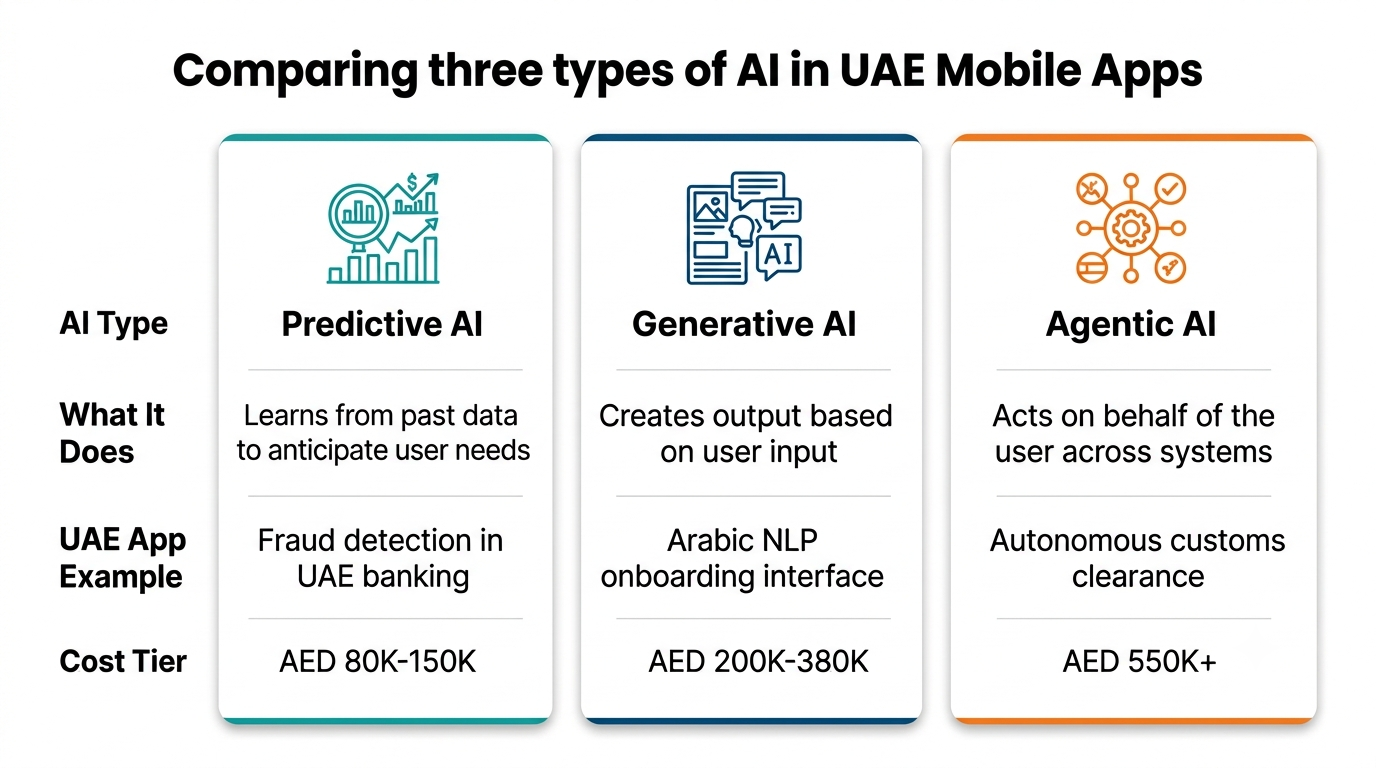
Three Tiers of AI in Mobile Apps
“Add AI” is not a feature decision. It is an architecture decision that must be made on Day 1.
Predictive AI:
Handles recommendation engines and fraud alerts. It uses historical data to anticipate what comes next.
Generative AI:
Generative AI powers NLP interfaces and content tools. It creates responses, summaries, and outputs based on user input.
Agentic AI:
Executes tasks across systems without user prompting. A user says, “Book me a meeting on Thursday.” The agent books it, confirms it, and updates the calendar.
Each tier carries a different cost ceiling, compliance requirement, and business case.
Why the UAE’s 2026 Moment Is Different
Three specific conditions converge in 2026 that rarely align in any single market.
Government Strategy:
As reported by the UAE AI office, the government strategy makes AI a national priority through the UAE AI Strategy 2031, with a targeted economic contribution of AED 335 billion.
Infrastructure:
Stargate UAE, a 1-gigawatt AI supercomputing cluster in Abu Dhabi, is now operational, reducing local inference costs.
Regulatory clarity:
PDPL and DIFC Regulation 10 give developers precise rules to build against. No other GCC market has all three simultaneously.
63% of mobile app developers globally integrate AI features in 2026. UAE sits above that sector average.
How big is the AI Market in the UAE?
UAE’s AI investment is not speculative. It is backed by government capital, measurable infrastructure, and specific regulatory timelines.
UAE National AI Strategy 2031 targets AED 335 billion in economic contribution. The target is for AI to represent 20% of non-oil GDP. CSIS, United Arab Emirates AI Ambitions.
PwC Middle East projects AI will add $320 billion to the Middle East economy by 2030. UAE captures the highest regional share.
IDC finds 78% of GCC enterprises will have deployed at least one AI application by the end of 2026.
According to Grand View Research, the MEA mobile app market is projected to reach $26.04 billion by 2030.
Infrastructure That Changes the Economics
UAE PASS serves 11 million users across 322 public and private services. It is the authentication backbone for any government-connected app. UAE Government.
Stargate UAE, the 1-gigawatt AI supercomputing cluster in Abu Dhabi, reduces local inference costs for UAE-built AI apps as capacity comes online.
D33 Agenda targets AED 100 billion in annual digital economy value. Sheikh Hamdan’s April 2026 directive requires all government services to integrate into a single digital platform within 12 months.
UAE mobile infrastructure: 95% mobile internet penetration, 23 million cellular connections.
Which UAE Industries Are Building AI Mobile Apps Right Now?
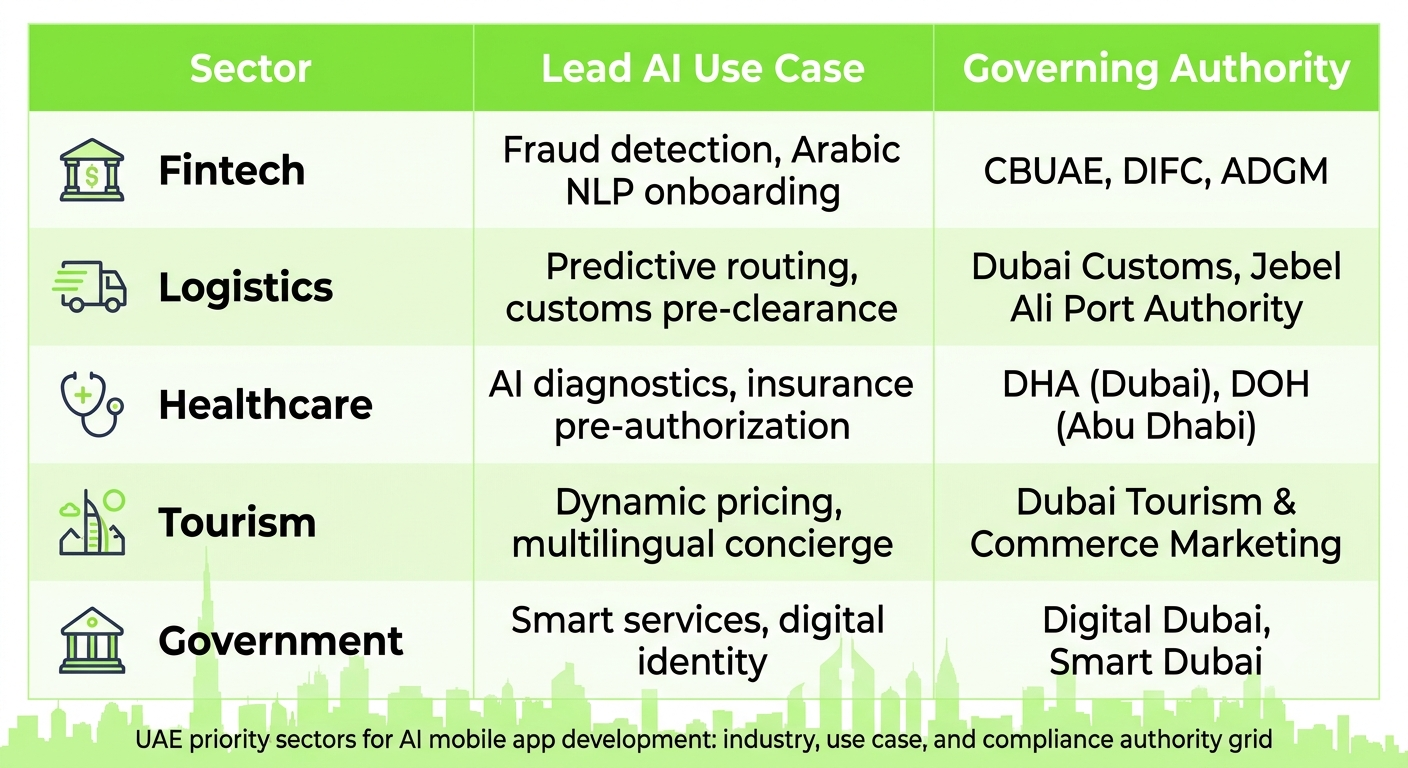
AI adoption in UAE mobile apps is not evenly distributed. Five sectors are moving faster than the rest, and each one carries distinct compliance requirements.
Fintech: Banking and Local Payments
UAE fintechs are deploying AI for fraud detection, Arabic NLP customer onboarding, BNPL decisioning, and real-time transaction monitoring.
CBUAE guidelines govern AI in financial services. DIFC-registered fintechs also operate under ADGM data regulations and DFSA guidance.
Compliance architecture and the build process must be sequenced together from Day 1, not added after development concludes.
Logistics: Air and Sea Transit Hubs
UAE handles over 13 million TEUs annually through Jebel Ali Port. AI apps in logistics cover predictive routing, multi-carrier rate comparison, customs pre-clearance, and fleet telematics.
An AI customs agent can reduce import clearance from 5 days to 18 hours for a company processing 400+ monthly shipments.
Healthcare: Genomics and Diagnostics
DHA compliance governs health data in Dubai. Abu Dhabi operates under DOH. Both apply to any app handling clinical records.
AI pre-authorization would reduce insurance approval time from 48 hours to 15 minutes at a UAE hospital. PDPL and Federal Law No. 2 of 2019 both apply to health data.
AI mobile apps in healthcare carry the highest compliance overhead of any UAE sector.
Tourism and Hospitality: Integrated Guest Services
Super-app convergence defines this sector. Careem spans ride-hailing, food, payments, and bikes. Talabat covers food, groceries, and dining.
An AI hotel pricing agent can deliver 23% revenue growth across 1,200 rooms by optimizing rate decisions in real time.
Government: Smart Services
Sheikh Hamdan’s April 2026 directive means government-facing AI apps must integrate UAE PASS, support Arabic-first UX, and meet UAI Seal of Approval criteria.
DHA, CBUAE, and Dubai Municipality all have active digital transformation programs underway.
How to Build an AI-Powered Mobile App in the UAE: The 7-Stage Process
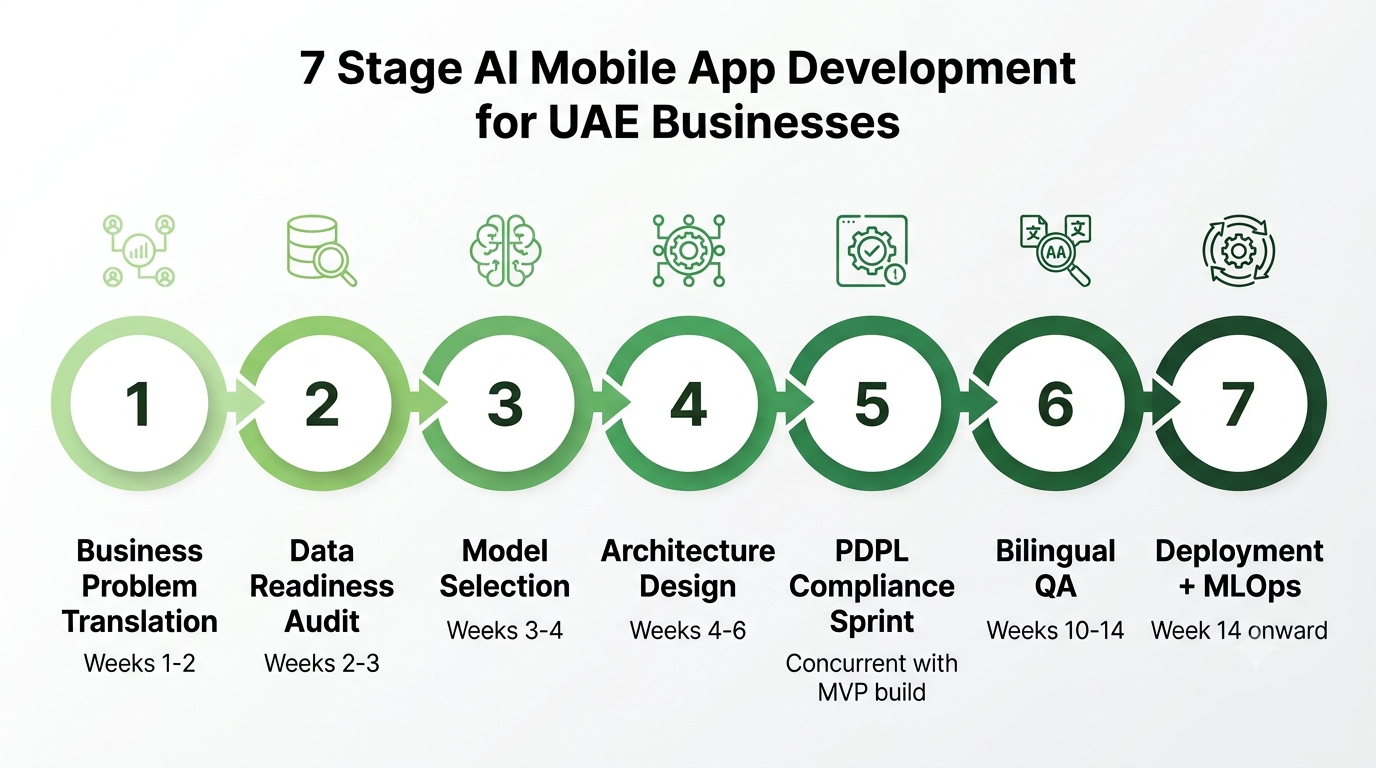
The build process for an AI-native app does not start with design. It starts with a data strategy.
Teams that skip this step rebuild 40% of their feature set post-launch.
Stage 1: Business Problem Translation
Define exactly what the AI system should improve, reduce, or automate.
Map business goals to data problems and measurable outcomes before any model selection begins. Without this step, the entire architecture is built on assumptions.
Stage 2: Data Readiness Audit
Inventory existing data assets: structured vs unstructured, Arabic vs English documents, historical transaction logs.
Quality beats volume. A clean, labeled 10,000-row dataset outperforms a messy 1 million-row dataset, consistently.
Stage 3: Model Selection
Three paths, each with different costs and timeline implications:
- API-based LLM (GPT-4o, Claude, Gemini):
Fastest to deploy. Scales with usage cost. No training data required.
- RAG pipeline (LLM plus vector database & your business data):
Recommended for domain-specific UAE apps. No custom model training needed.
- Custom model training:
Rarely necessary. Only warranted when proprietary data is core IP and API-path inference cost is uneconomical at scale.
Stage 4: Architecture Design
Define data residency zone (AWS UAE, Google Cloud UAE, or Azure UAE), vector database choice (Pinecone, Weaviate, pgvector), and agent orchestration framework (LangChain, LlamaIndex, Anthropic tool-use API).
Flutter is the preferred frontend for 60% or more of new Dubai apps in 2026. It delivers cross-platform iOS and Android with native Arabic RTL support.
Stage 5: PDPL Compliance Sprint (Concurrent with MVP Build)
Consent management, DSAR handling, data residency enforcement, and audit logging are not post-launch activities.
PDPL compliance built from Sprint 1 costs AED 7,000 to 37,000. Retrofitted after launch: 3 to 5 times more.
Stage 6: Bilingual QA
This is not a translation pass.
It is a parallel testing track covering Arabic RTL navigation, mirrored icon alignment, bidirectional content rendering, and UI behavior across device form factors. Every screen gets tested separately.
Stage 7: Deployment and MLOps
Establish model monitoring for drift detection, API cost tracking per user session, response caching to control LLM inference spend, and a feedback loop for model retraining.
AI apps without MLOps degrade silently post-launch. There is no visible failure signal until users stop returning.
AI Mobile App Architecture: Best Tech-Stack for AI Mobile Apps
Architecture determines whether your AI app scales, stays compliant, and remains economical at 100,000 daily users versus 1,000.
Every layer in the stack has a UAE-specific constraint. Ignoring one layer compromises the whole system.
Frontend:
Flutter delivers a single codebase for iOS and Android. It is the standard choice for UAE apps in 2026 because of native Arabic RTL support and performance parity with native builds.
iOS market share in the UAE is approximately 55%, versus 27% globally, driven by purchasing power. Build cross-platform first. iOS-first optimization comes second.
AI Integration Layer:
API-based AI is easiest to implement. It provides automatic model updates and usage-based cost. It is the right choice for 80% or more of UAE business apps.
On-device (edge AI) runs capable small models locally on Apple A18 and Google Tensor Neural Processing Units.
It enables offline AI, reduced latency, and no data leaving the device. This is the emerging choice for privacy-sensitive sectors: healthcare and government.
Hybrid architecture routes time-sensitive queries to the edge and complex reasoning to the cloud. This is the architecture of choice for fintech and logistics.
Data Layer
Use traditional databases (PostgreSQL, MongoDB) for transactional data and vector databases (Pinecone, Weaviate) for semantic search, RAG retrieval, and recommendation engines.
UAE data residency requires data to reside in AWS UAE, Google Cloud UAE, or Azure UAE zones for PDPL compliance. Confirm service availability for AI-specific services before committing to a zone.
Agent Orchestration (Agentic Apps)
LangChain, LlamaIndex, and Anthropic’s tool-use API are the primary frameworks for multi-step agent logic in production.
Agentic apps require a model inventory register and audit trails for every tool call. This is not optional for UAE-regulated sectors.
CBUAE and DIFC regulators expect documentation of every agent’s data access scope and accountability owner.
Arabic NLP Requirements
Standard NLP APIs treat Arabic as a secondary language. Verify provider support before committing.
Requirements include Gulf dialect variation support, right-to-left interface design, culturally appropriate conversational flows, and entity extraction from Arabic documents.
How much does AI Mobile App Development cost in the UAE?
| App Tier | Description | Estimated AED Range | Timeline |
| Basic AI MVP | LLM API chatbot or copilot, single-use case | AED 80K-150K | 6-8 weeks |
| Mid-Tier AI App | RAG pipeline, bilingual UI, 2-3 user roles | AED 200K-380K | 4-7 months |
| Enterprise AI Platform | Custom workflows, PDPL compliance, multi-agent | AED 550K-1.2M+ | 9-18 months |
Key Cost Drivers
PDPL compliance (from Day 1): AED 7,000 to 37,000. Retrofitted post-launch: AED 35,000 to 185,000.
Arabic RTL QA pass: AED 15,000 to 40,000 depending on screen count.
UAE data residency hosting: AED 500 to 2,000 per month above standard cloud pricing.
DHA compliance architecture (healthcare apps): adds AED 22,000 to 55,000 to the build cost.
Annual maintenance: 15 to 25% of the initial development cost per year.
Total Cost of Ownership Reality Check
The development quote is the build cost. Year 1 total cost of ownership is 1.5 to 2 times that figure once hosting, maintenance, LLM API usage, and App Store fees are included.
Cost Optimization Levers
-
- Cross-platform Flutter vs native: Saves 25 to 45% on a two-platform build.
- API-based AI vs custom model training: Custom training is rarely necessary and 3 to 6 times more expensive.
- R&D tax credits: Dubai Internet City and Dubai Silicon Oasis offer AED 250,000 in R&D credits for qualifying AI projects from 2026.
- Offshore hybrid teams: UAE-based project management with offshore engineering reduces labor cost by 30 to 50% without quality compromise.
See what your AI app build requires.
What UAE Compliance do AI Mobile Apps need?
There is no single UAE AI Act.
What exists is a layered framework of data protection laws, free-zone regulations, sector-specific rules, and ethical guidelines. The compliance obligations depend entirely on which layers cover your app.
UAE PDPL (Federal Decree-Law No. 45/2021)
PDPL applies to all personal data processing on the UAE mainland. It also applies to the data of UAE residents processed outside the country.
Consent is the default lawful basis. There is no “legitimate interests” equivalent to GDPR.
Full compliance is mandatory by January 1, 2027. Criminal liability for unlawful data disclosure: fines from AED 20,000 plus up to one year in prison under the Cybercrime Law. WCR Legal
DIFC Regulation 10 (AI-Specific)
In force since January 2026. Requires AI impact assessments, transparency obligations for AI-driven decisions, and documentation of high-risk AI use cases.
Fines: USD 25,000 to 50,000 per violation. Applies to all DIFC-registered entities. DIFC DP Law 2020 (amended 2025) runs concurrently. Data subjects hold a private right of action.
CBUAE Guidance (Fintech and Payments)
Fintech AI apps must demonstrate explainability of credit and fraud decisions, maintain audit trails, and pass CBUAE licensing review for AI-driven payment processing.
DHA and DOH (Healthcare)
Apps handling clinical data in Dubai fall under DHA oversight. Abu Dhabi operates under DOH. Both apply simultaneously for health apps. DHA compliance architecture adds AED 22,000 to 55,000 to a standard healthcare app build.
UAE PASS Integration
Required for apps connecting to any government service.
Integration requires the approved UAE PASS SDK and compliance with Digital Dubai’s integration standards. Apps serving government entities should also plan for UAE PASS compatibility as a procurement requirement.
UAI Seal of Approval
The UAE AI Office’s ethical certification program for AI products.
Not mandatory for private apps, but increasingly expected for enterprise procurement and government contract consideration. It demonstrates alignment with UAE AI Ethics guidelines (2022).
Arabic RTL: The Regulatory Dimension
For government-connected services and TDRA-regulated communications apps, Arabic-first interface support is a regulatory requirement.
RTL affects navigation flow, icon alignment, bidirectional content rendering, and every QA screen.
Why do AI Mobile App Projects fail in the UAE? (And How to Avoid)
Most UAE AI mobile app project failures are not technical. They are architectural and operational: decisions made in discovery that become expensive corrections twelve months into the build.
Challenge 1: Legacy System Fragility
Most UAE enterprises run on ERP, CRM, or government portal infrastructure not designed for API-first AI integration.
Fix: Conduct a system audit before any AI architecture decisions. Identify which legacy endpoints can accept real-time AI calls and which need middleware first.
Challenge 2: Data Cleaning and Ownership Gaps
Unstructured data (Arabic PDF contracts, WhatsApp messages, scanned government forms) requires OCR, entity extraction, and classification before it can feed any AI model.
Fix: Ownership ambiguity over training data in a JV or government partnership must be resolved in contracts before development begins.
Challenge 3: Model Drift After Launch
AI apps degrade when the underlying model’s training distribution diverges from live user behavior.
Fix: MLOps monitoring, scheduled retraining triggers, and drift detection alerts keep an AI app accurate 12 months after launch. Without these, accuracy drops with no visible warning signal.
Challenge 4: Agent Sprawl
Enterprises deploying multiple agentic AI tools across departments risk accumulating autonomous agents that cannot be audited or traced.
Fix: CBUAE and DIFC regulators expect a model inventory register: a living document of every agent, its data access scope, and its accountability owner.
Build an AI mobile App with compliance-first, PDPL architecture, and Arabic RTL
UAE AI Mobile App Development Trends: 2026 to 2030 Strategic Outlook
Trend 1: Agentic AI as the New Standard
The shift from generative (AI that responds) to agentic (AI that acts) is the defining architectural change in UAE mobile development.
Agentic apps do not answer “how do I book a flight?” They book it, confirm it, and add it to the calendar. Dubai Chamber of Commerce incubators and funding programs now target agentic AI adoption. NomadX
Trend 2: Arabic-First AI Systems
MBZUAI (Mohamed bin Zayed University of Artificial Intelligence), in partnership with IBM, has an active AI Center of Excellence focused on Arabic NLP, including Gulf dialect processing.
Apps built for UAE residents from 2026 onward will be evaluated on Arabic-first capability, not treated as an afterthought.
Trend 3: On-Device AI (Edge Intelligence)
Apple A18 and Google Tensor chips now run capable LLMs locally.
For sectors where PDPL data residency creates cloud latency or sovereignty constraints, including healthcare, government identity, and banking, on-device inference becomes the architecturally correct choice.
Trend 4: Stargate UAE Infrastructure Impact
The 1-gigawatt Stargate UAE supercomputing cluster in Abu Dhabi will lower the cost of high-complexity AI inference for UAE-based companies.
Enterprise AI apps requiring intensive model compute, including genomics, multi-modal vision, and real-time Arabic translation, will see reduced infrastructure costs through 2027 to 2028.
Trend 5: Super-App Consolidation
Over half of UAE residents prefer a single digital platform that handles multiple service categories.
The Careem model (ride-hailing, food, payments, bikes, home services) is the dominant consumer playbook. AI is the layer that makes cross-vertical personalization coherent.
Trend 6: National Virtual AI Institute and Talent Pipeline
One of the UAE AI Strategy 2031’s eight objectives is the establishment of a National Virtual AI Institute.
As this matures through 2027 to 2028, domestic AI talent supply will grow, reducing current reliance on hybrid offshore teams for UAE AI projects.
Conclusion
The UAE is not an emerging AI market. It is an AI-mandated economy with a 2027 compliance deadline and a 24-month agentic AI window.
The gap between businesses with a production AI app and those still in planning is not closing. It is widening.
Building an AI-powered mobile app in the UAE correctly means starting with data readiness, designing PDPL compliance into the first sprint, treating Arabic RTL as architecture, and choosing between API-based, RAG-powered, and agentic builds based on where your business generates ROI fastest.
Code Brew Labs has delivered AI-powered mobile solutions across the UAE’s priority sectors: fintech, logistics, healthcare, government, and tourism. The process starts with a free scoping session.
FAQs
Q1: How much does AI-powered mobile app development cost in the UAE?
AI-powered mobile app development in the UAE costs between AED 80,000 for a basic LLM chatbot MVP and AED 1,200,000+ for an enterprise platform with PDPL compliance, Arabic RTL support, and multi-agent orchestration. A mid-tier RAG-powered app typically falls between AED 200,000 and AED 380,000. Year 1 total cost of ownership is 1.5 to 2 times the development quote when hosting, maintenance, and LLM API usage are included.
Q2: What is Dubai’s agentic AI mandate?
Dubai has directed private-sector businesses to adopt autonomous AI agents within a 24-month window, backed by Dubai Chamber of Commerce training programs, dedicated incubators, and funding support. Agentic AI means software that perceives a situation, reasons toward a goal, and takes action across systems. Companies that have not started planning should begin with an AI readiness assessment.
Q3: Do UAE AI apps need to comply with PDPL?
Yes. The UAE Personal Data Protection Law (PDPL, Federal Decree-Law No. 45/2021) applies to any AI app processing personal data of UAE residents, including apps hosted outside the UAE. Full compliance is mandatory by January 1, 2027. DIFC Regulation 10 (AI-specific) has been in force since January 2026 for DIFC-registered entities, with fines of USD 25,000 to 50,000 per violation.
Q4: What tech stack is used for AI mobile app development in the UAE?
Flutter is the standard frontend for UAE AI mobile apps in 2026, covering iOS and Android with native Arabic RTL support. The AI layer uses OpenAI, Anthropic Claude, or Google Gemini APIs with RAG pipelines via Pinecone or Weaviate vector databases. Python or Node.js backends handle AI service routing. UAE data residency requires AWS UAE, Google Cloud UAE, or Azure UAE zones.
Q5: How long does it take to build an AI mobile app in the UAE?
A basic AI MVP takes 2 to 4 months. A mid-tier RAG-powered app with bilingual UI and compliance architecture takes 4 to 7 months. Enterprise AI platforms with custom agent workflows, deep integrations, and full PDPL compliance require 9 to 18 months from scope to production. Teams that begin with a data readiness audit reduce mid-build delays.
Q6: What is UAE PASS, and do I need to integrate it?
UAE PASS is the national digital identity authentication system used by 11 million users across 322 public and private services. Apps that connect to any government service, utility, or digital government portal must integrate UAE PASS. Apps serving government entities as a client should also plan for UAE PASS compatibility as a procurement requirement.
Q7: What industries are leading AI mobile app development in UAE?
Fintech, logistics, healthcare, tourism, and government services are the five sectors moving fastest in UAE AI app development. All five are named priority sectors in the UAE National AI Strategy 2031. Healthcare and fintech carry the highest compliance overhead. Logistics and tourism show the fastest deployment of AI features with measurable ROI.
Q8: What is the UAE AI Strategy 2031, and how does it affect app development?
UAE National AI Strategy 2031 targets AED 335 billion in AI-driven economic contribution and aims for AI to represent 20% of non-oil GDP. For app developers, it means a government ecosystem actively funding AI infrastructure through Stargate UAE, credentialing ethical AI via UAI Seal of Approval, and mandating AI adoption in government customer services.
Let's Convert Your Business Idea Into Success!
Free Consultation from Top Industry Experts
Let’s Build Your Dream App!
Share article on :